Showing posts with label in-game economy. Show all posts

Wednesday, August 29, 2012

The Privation of WoW

Since the Starter Edition came out for World of Warcraft, being an unlimited free trial with a cap of level 20, I occasionally drop in and play the post-cataclysm low-level quest content that was all new to me, or try different races and classes.

I typed up all my experiences and impressions of that content, but never finished the article or uploaded it here. The basic summary is that they had stripped the gameplay and the leveling experience of at least half of its previous depth. Perhaps in the future I'll explain why I feel that way.

Now, with the new expansion Mists of Pandaria, Blizzard opened up the goblin and worgen playable races to the Starter Edition, enabling me to create a new character of each of those races and experience their unique 1-10 leveling zones.

In so doing, however, despite the new (to me) content to experience, I found that they've removed even more gameplay, depth, and immersion from the game.

At one time, you got to know your choice of class through interactions with your class trainer and class-specific quests, which provided a grounding in what it means to be whatever class you chose. New abilities were given as rewards for going through certain rituals or rites of passage, and class quests would send you out to assemble unique items perfectly suited to your class, which taught you what kind of gear you should be looking for in the future, though these class quest rewards were often so good, you'd be using them for the next 10 levels before you could find anything better.

In general, class quests were integrated into the questing experience at least all the way up to level 55 (pretty much the end of the vanilla game), when every class was funneled into the Sunken Temple for their class quests, so really, you could go through the entire game and experience new content all the way through just by picking a different class. They really made classes feel distinct and interesting, with plenty of backstory.

Cataclysm removed most of the class quests. What previously was a reward for a chain of interesting quests was turned into something you just pay to learn at a trainer. If you didn't play it before, you'll never experience the flavour that used to give it meaning.

They also removed most of the class-specific items. Warlocks don't really need soul shards anymore. Hunters don't need ammunition or pet food. Rogues don't need to brew their own poisons.

Okay, so that's all just a little summary of a couple of the small things that were changed in Cataclysm (instead of the long unfinished article on that and many other things), as a lead-up to what I've just experienced in the changes brought by Mists of Pandaria.

The biggest thing is that now, in MoP, they give you all your class abilities automatically, for free, with no training. Trainers are now nothing more than providers of basic information and respecs. The last tenuous connection to that old sense of involvement in the game world is now broken. I no longer feel like I'm a part of something, at all.

Moreover, what was previously a gold sink is now gone. What am I supposed to do with all this gold, now that I don't have to pay for talents or class-related materials?

Really, the only vestige of what class quests used to be is now only to be found in the repeatable quests for cooking and fishing. There are 5 randomly-assigned daily quests in each major city for each of those professions that send you off to do things related to that profession, with the quest text providing some feeling of being a cook or a fisher in that world, and giving quest rewards related to that profession. That's fun! And it's a shame the classes have had that sort of thing taken away from them.

Monday, April 23, 2012

Neverwinter Nights 2, part 5

My apprehension at keeping all of my blog posts in a single file was justified. One surprise error while saving caused the loss of a month's worth of blog writing, about half of which had not yet been posted. I'll need to find a more stable solution, but in the meantime I'm making more frequent backup saves. This is what I've reconstructed of the second-to-last post about the NWN2 original campaign.

Crossroad Keep

The game is much longer than I was expecting. After battling what seemed to be a major enemy at the ruins of Crossroad Keep, I found that as a reward for my service I had been given the keep and its lands as a fixer-upper project. So now, apparently, I'm a landed noble, with a personal army, administrators, and my own peasant farmers to work the land, if I understand correctly. It'll be a giant gold sink, considering all the repair work that needs to be done, so it's a good thing I haven't spent much on the higher-level gear I've been seeing at some merchants.

This keep is much better laid out than the stronghold I was given in Baldur's Gate 2. Even though it's very large, there are characters stationed at all the important spots who I can talk to and be teleported to any other area. Additionally, there's a lot more to do there, such as making decisions on local policy, forging alliances, and sending other characters out on quests instead of doing quests for other characters.

The basement has a storage shelf and all three crafting stations, so perhaps this is what I should use as storage, instead of keeping it all on Casavir.

The improvements to be made at the keep are split into two areas -- manpower and repair/expansion. After talking to each of the heads of those departments, I decided to start by expanding and fixing up the roads that pass by the keep, to attract more merchant caravans, and I also told the chief of staff to recruit more soldiers, so I can later train them and set them out to patrol those roads, which is another necessary step to attract more merchants.

Guyven of the Road was there, too, and he talked about maps and finding nooks and crannies, but he didn't have any details, so I assume that's for later development.

While I was in the area, I went back to West Harbour to drop off a tithe box I'd been asked to deliver there, and see what may have developed on the homefront in the meantime. Nothing had, apparently. People were still walking around injured, houses were still wrecked from when I left, and I could still hear sound effects of fighting and screaming, and house fires in some spots. I did manage to finally get this "Wizard's Arsenal" quest out of my log book, though. It was a quest from the beginning of the game, which I had successfully completed at the time, but which was inexplicably re-added to my quest journal shortly thereafter. It had been stuck in my journal ever since then, even though I had entered that house several times trying to trigger something to get rid of it. Entering the house again at this later time made it disappear again.

Also in West Harbour, I found that I could bring one of the local farmers to Crossroad Keep to get the farms productive again. I think this keep might be an opportunity to help out that miner I met back in Port Llast, as well, who was looking for work. In any case, it seems that the keep adds a significant management minigame to the overall game, and it's a welcome improvement over other games' strongholds.

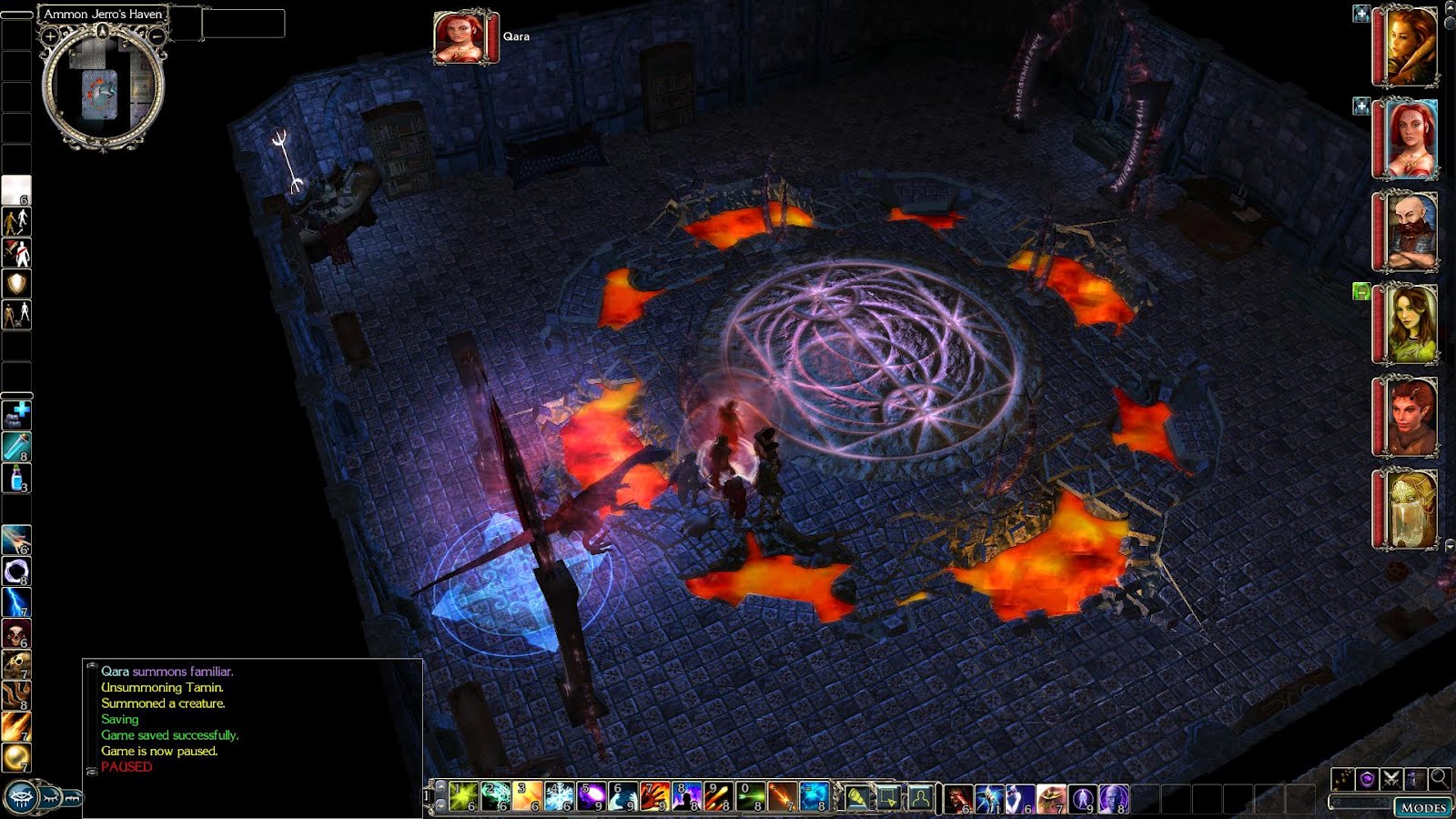
Incidentally, Crossroad Keep uses one of the tilesets with the worst kind of overdone normal maps (see picture). The stonework in the interiors looks like it's been exposed to about 2000 years of harsh weather, or else the stonecutter's guild was working with extremely crude chisels. Seriously, some of the normal maps in this game look like they were trying way too hard to point out the realtime shadows of the engine by making everything rough and pitted to absurd extremes.

Ruins of Arvahn

We were directed toward these ruins as part of the main quest. Approaching them caused that "Wizard's Arsenal" quest to pop up in my log book again! I was just walking along, and suddenly "Ding! *scribble*" my journal was stuck again with the quest from the beginning of the game to scrounge for starter weapons back in my hometown.

This was a pretty lengthy area, where I had to find and activate 5 statues, though the design of the place was rather uninspired. The first statue was right in front of the first fork in the road, three more were in dungeons in this zone, and the last one had to be reached through a portal that only opened once the first four were activated.

This area contained several tribes or factions that could be befriended or eliminated. I chose to befriend the first tribe of orcs, who seemed reasonable enough, refused an offer of alliance with a small band of infiltrators inside a dungeon because they were arrogant and threatening, and fought the ogre mage inside, because he was also rather arrogant and attacked me even when I merely declined to kill the orc leader for him.

The dungeons were pretty fun, with their own themes and objectives, and story exposition. One of them, Riverguard Keep, involved a kind of collection quest to gather items to open a door that led to one of the statues.

The gem mines involved a little puzzle in herding certain ghosts past obstacles into a central room, where they could perform a ceremony that would summon another one of the statues. This was also the site of a pretty funny bug, in which I was in conversation with one of the ghosts, and during the conversation, someone detected a nearby trap. I was surprised to see Neeshka automatically walk over to it and disarm it while we were still talking, and in the process, she apparently caught the attention of some enemies. So while my character was still stuck talking to this ghost, I was hearing the sounds of battle from offscreen, and seeing what little glimpses I could see of it when the fighting overlapped the cutscene camera angle.

The Temple of Seasons presented a series of season-themed challenges, each in an appropriately decorated room, and once all of the challenges were beaten, the door to one of the statues was opened. That one was the quickest run of the lot.

After passing through the final portal, I was redirected to (and I'll hide this in a spoiler tag) West Harbour, my hometown.

Spoiler: Click to display/hide

This hidden spoiler block contains an event spoiler

In regard to that, surely the designers must have had some kind of plans for an emotional connection for this scene. Why else would they have sent me here? There's nothing for me to do here. The portal was supposed to send me to the nearby Merdelain, to that one building that couldn't be unlocked when I passed through that location earlier in the game.

Anyway, I passed through that place and came to the last of the statues, in that building. Alas (or happily, considering it means more gameplay), there is another complication, and the statue is destroyed. But the foe within tells me that someone else had just been here and had received the statue's blessing, so now I just have to find that person. I figured it would be Bevil, my childhood friend, who was mentioned as having been heading into Merdelain when I had previously been in West Harbour.

Haven

Next stop was Ammon Jerro's Haven. Ammon Jerro was Shandra's grandfather, who she remembers as a kindly wizard. This was confusing to me, since I already knew that the mystery warlock is in fact Ammon Jerro, though it might not have been mentioned in the game yet. Anyway, the door to the Haven was magically barred against everyone except relatives of Ammon Jerro, so of course Shandra was there to open the door for us.

But Shandra's ancestry wasn't everything we needed. We also had to pass a few trials before we could get in, and that involved going around the area outside the Haven to gather items and kill mobs. The area's design showed some notable improvements over many of the previous areas. There were points of interest at different levels of elevation, a refreshing change of texturing that made even this dry desert area look good, and the mob placement was nicely distributed as well. The encounters were rather simple, though, and it left me wishing there had been a little more to do in this area.

Once we got inside, we were treated to a series of encounters with some bound demons who were willing to negotiate with us if we'd agree to help them out with their workplace bickering, getting their petty revenges and such. Shandra had been separated from us, and it seemed fairly comical at the time that she kept teleporting around trying to find us, always leaving a place just before we got there.

It was pretty straightforward getting through this place, though I had to watch helplessly as Shandra did some unnecessary things with no way to intervene, and it all culminated in a boss fight with Ammon Jerro himself, and ultimately the worst, least-engaging death scene yet.

Afterward, I was given an opportunity to rest and swap any party members if needed at the tavern on the property of Crossroad Keep, before a suddenly rude Sir Nevalle showed up to insist I go to Castle Never right then, with a little threat that I shouldn't get too comfortable here at Crossroad Keep, because it could be taken away from me at any time. Bizarre behaviour, considering the reason for summoning me turned out to be that Lord Nasher wanted to grant me full knighthood. This marked the end of Act 2.

Act 3 interlude

Act 3 started with the most frustrating and irritating thing I can imagine. Yet again, a developer gets the asinine idea that it would be a wonderful gameplay mechanic to suddenly strip away all my companions and drop me into a horde of elite vampires and wraiths after a bloody long cutscene with many unskippable parts! Arrrrghhh! I'm a squishy caster, not a tank! Why do so many bloody games do this? Developers: I hate this, and I don't respect this kind of design decision! I'm playing NWN2 for its party-based gameplay. If I wanted to be playing a solo hack & slash, I'd be playing an Elder Scrolls game.

After numerous reloads, even after setting the difficulty to the easiest level just to get through this moronic meatgrinder section (which I've never had to do in this game yet), only to find more shadow priests, shadows, and elite vampires waiting for me when I went "down the hall" to look for a secret door Sir Nevalle told me to find. That's when I resolved to get through it by any means necessary, so I could get back to an enjoyable part of the game.

I have to guess that the "party roster" option from the player menu at the bottom left of the screen must have been added by one of the expansions, because I was able to use it here to re-add my companions to my party, even though the setup here expects me to be playing it solo. I used that to get past the monsters, and then stuck through the rest of it solo (just in case it might have interfered with game scripts if I had a party), and eventually I was returned to Crossroad Keep with a new set of quests ahead of me, and all my companions gathered around to greet me. What a relief!

I think one more post should finish the OC, but like I said, this game is really long. I've skipped over a lot of things, and barely touched on others. I'm impressed.


Dead Nasher, or just a knockdown?

Friday, July 22, 2011

Space Trader: Merchant Marine

One of the other game genres I enjoy is economic trading games. I own and enjoy Patrician 3: Rise of the Hanse, Darkstar One, X3: Terran Conflict, and X3: Reunion. I also own Port Royale, but I haven't actually tried it yet. All of these games involve running your own goods transport business. You purchase a ship or fleet of ships (seafaring or spacefaring), buy goods at low prices, and transport them to other places where you can sell them for high prices. Most of these games offer modes that set up specific challenges for you to meet, usually with a time limit. Each of these games also has something unique that sets it apart from the others, but for now I'm going to focus on my latest acquisition, which is Space Trader: Merchant Marine.

The campaign begins with you as a new, unknown person with no money and no ship. In the first chapter, you have to find someone willing to loan you the capital you need to get started, then earn that money back in a certain time limit. In this first chapter, you're limited to only two ports to trade between (Earth and the Moon), which is expanded more and more in each chapter. As you make more money, you can upgrade your ship to carry more cargo, and you can also afford to buy the more expensive wares that return a much larger profit than the cheaper items that take up the same amount of space.

I bought this during the latest Steam summer sale, when it was cheap enough to take a chance on, especially since I'd never heard of it, and it showed very mediocre reviews. The trailer, which was an unusually helpful trailer showing actual gameplay rather than a pre-rendered cinematic, showed that this game includes one thing that's missing from every other game in this genre that I've ever seen, and it's one that I've really wished would be included: the ability to leave your ship and walk around in all these locations you visit. In X3, you never leave your ship, which must smell pretty bad after a while. In DS1, your character leaves the ship only in cutscenes, and never under your control. In Patrician and probably Port Royale, you don't really have a noticeable presence at all, and just exist as an omniscient overseer of your operations, able to see any town where you have an office or a ship in port.

Space Trader sort of reverses this setup. Here, you don't actually experience the travel parts of the game. You mark where you want to travel to, and you get a summary screen showing what's changed in the time during your travel, and then you arrive! This sacrifices the freedom and scenic starscapes of the X series, for certain, but travel in the X series is, for the most part, extremely slow and tedious, so this is a very welcome change.

The campaign

Once you've arrived, you're free to walk around the place, talking to people, making new contacts, buying/selling, picking up side jobs, and following the main quest. Bartenders offer bounty missions, various NPCs offer story-type missions or want specific items (with familiar yellow question marks and exclamation points over their heads), and random events (such as famines or plagues) on different planets can provide opportunities for extra profit.

Boxes of free cargo are also scattered around all over these maps, sometimes hidden, and sometimes placed in locations that require careful jumping. Of course, you can get along without any of this free stuff, but you can take it as part of the challenge of the game, too, if you like, since the percentage of boxes you found is one of the things that's tracked in the summary screen whenever you leave a location.

Another feature that eliminates the tedium of travelling (in this case, walking from one trader to another while you're in port) is the option to instantly teleport to any other trader on your contact list for that location. This makes it easy to check prices, since they each carry different wares, and can also be used as a shortcut to teleport to a different section of the port for cargo-collecting purposes. Don't do this exclusively, though, because there are usually a couple of extra traders in each location that don't appear on your contact list until you find them in person.

There's also a bank system that allows you to either put money into your account to gain interest while you travel, or to take out money as a loan with interest if you happen across a very profitable opportunity. The bank is always instantly available, and there seems to be no penalty for transactions aside from the interest, so there's no reason not to put all your spare cash into the bank every time you travel.

Taxation seems to be a random event in Chapter 5, and it can be pretty outrageous. It goes along well with the general corruption and dirty dealings that take place throughout that chapter. If you like, you can choose to resist the taxes, in which case you enter combat with the Ministry of Accounts soldiers who board your ship. If you do, however, you gain a criminal record, and attacks will become more frequent and more difficult to overcome.

Combat

Speaking of combat, this is the part that's really different about this game from the others. The other games involve ship-to-ship combat (space flight combat in X3 and DS1, and cannon-based sea combat in Patrician), but this game never actually has you visibly travelling in your ship, so the combat here is first-person shooter combat!

The movement and gameplay of these missions remind me of Quake 3 Arena (or OpenArena), or Unreal Tournament. Fast-paced, with health, shield, and weapon pickups, automatic doors and lifts, and a bunch of bots running around the map looking for you. A handy minimap shows the items and enemies around you, as well as the free cargo lying around for you to take. Enemies drop money, and bosses drop money and a good amount of cargo.

You get three chances to beat such an instance, respawning with the default pistol each time, but any enemies you killed are still dead, and the boss seems to retain whatever damage you did to it before dying.

No matter how rich you are, however, you start every FPS encounter with no shields and a default pistol, and have to scavenge your gear from the level pickups. I can forgive this mechanic, though, because if your money influenced your loadout, then it would add several problems. First, the missions would be too easy against simple bounties. Second, the money should also influence your enemy's loadout, so well-connected targets that are much richer than you would be almost impossible to beat.

One of them did seem to be impossible for me, at first, and that was the final boss of chapter 3. Even with three respawns, I failed the scenario twice, and had to wait before being allowed to try again. I was getting dangerously close to the time limit for the chapter, as well, which made it rather tense. What made it especially difficult was that several times I was respawned in the same room as the boss, who immediately began shooting at me before I could even orient myself, let alone find a better weapon! Luckily, I did succeed on the third try, and completed that chapter to unlock more locations to trade with.

These combat missions are offered by various NPCs at various times, but the bartenders at each of the ports usually have at least one available. Strategically, it seems like it's best to take as many combat missions as you can find as soon as you've sold off your cargo when you arrive at a new location, and before you start picking up free cargo around the port or buying anything, so that you'll have as much free cargo space as possible to pick up all the loot in these combat missions.

Non-campaign challenges

There are three challenges outside of the campaign, which isn't very many. They need to be played in order, since you have to unlock the second and third by beating the previous challenge. The first one is a beginner's challenge, and in some ways it's just as much of a tutorial as the first chapter of the campaign, though it includes several things that the campaign didn't mention. It seems that a beginner to this game should play the first challenge here first, and then go on to the first chapter of the campaign.

There are numerous conditions and mechanics that exist in one challenge or chapter, but not in others. In the campaign, there seems to be absolutely no disadvantage to dealing in black market goods, but in the challenges there are some legitimate vendors who refuse to do business with you if you're carrying certain kinds of contraband. The Ministry of Accounts is also said to do raids and crackdowns randomly during travel between planets if you're carrying any contraband, but it's apparently only in the challenges, and not in the campaign. The campaign's 5th chapter, on the other hand, requires you to set up a trade office and hire some merchants of your own, which doesn't happen in any of the other challenges.

Factions

The 3rd chapter of the campaign throws an unexpected twist into the gameplay -- that being that if you start doing jobs for the leaders of any of the trade conglomerates, you'll suddenly find that members of rival conglomerates will start refusing to do business with you. I've read about that kind of underhanded anti-competitive dealing in Anthony Bourdain's book Kitchen Confidential, but never saw that sort of thing in a trading game.

The impact it has on your trading is that although you can still sell any items you're carrying, you lose the ability to buy anything at that location that only those merchant sell. This also means you can't compare those prices to the market value, since it's shown in their inventory screens, so you'd be selling without knowing if it's a good deal or not.

This mechanic was only in Chapter 3, though, and not in the later ones, and doesn't seem to be in any of the challenges, either.

Comedy

There's plenty of comedy in this game's dialogues, and it adds a great deal of enjoyment to the experience. Much of it is self-aware or self-referential, with the game poking fun at itself, such as in a dance club on Venus, where the bartender says "This place is pretty dead. Everyone's just standing around!" Robots tend to use internet acronyms in their vocal greetings, such as "OMG 1337", and one of them is named XKCD, likely named after the webcomic of the same name.

I think one of the voice sets was supposed to be comedic, as well, but it rather comes off as annoying. I'm speaking here of the whiny, lisping, mush-mouthed voice that really stands out from the others in its campiness.

The story missions have a lot of whimsical and goofy situations, and even some dark comedy on occasion, which is really good for a laugh. One NPC claims to be turning into a werewolf, and demands some silver to prevent it. A technician in a water treatment plant mentions that one of the job perks is getting to swim whenever he wants to. Your dialogue responses are usually amusingly sarcastic or snarky, too.

Graphics and music

The graphics are nothing special. They pretty much resemble the graphics from Star Wars: Knights of the Old Republic, actually. Rather low-poly, with interesting but basic texture work. The plus side is that it plays quickly and smoothly with the resolution and graphics settings maxed out, and graphics aren't the draw of this game anyway.

The music is light electronic music. Inoffensive, but unremarkable and repetitive. I turned the music off and played my own music in the background after a while.

Conclusion

I like this game! I had a great time playing the campaign, and was sad to see it was over, with only the challenge modes left to play. There are also still numerous Steam achievements I can shoot for, which is more or less equivalent to another challenge mode condition. The game was exactly as the trailer made it out to be, and I'm quite satisfied with it.

I do wish it had a longer campaign, and that the FPS parts would always respawn me in a safe location. I also wish there were more locations to travel between, with a more developed supply/demand mechanic. Patrician 3, for instance, has 24 cities that you can sail between, and most of those cities have certain items that they produce, so it's best to buy those items from those places, and never try to sell those items there. The other games have many more locations than that! Space Trader, on the other hand, has only five locations in the biggest part of the campaign. More locations would certainly help with its scope.

In what turned out to be the last chapter, some NPCs started dropping some hints that another faction-based challenge was coming up, and the ending text of that chapter also sounded like I was in for a difficult time, but it unexpectedly ended there, which was a bit disappointing. Perhaps more was planned, but cut out.

I'm not sure how much replay value it has, aside from the two times I had to repeat a chapter due to running out of time. After figuring out what I needed to do in those chapters, time was really not much of an issue. This is the kind of game that should be easy to write new challenges for, and it would be nice if there were some community-written ones, but I'm afraid it's too small of a niche game, and those bad reviews are certainly not helping.

I had fun, though, and it brought me smiles, so I'm satisfied.

Thursday, April 29, 2010

Adieu to Allods

Following is a criticism of the PvP in Allods Online. If you like the PvP there, this post is not for you.

The PvP beast began to rear its ugly head around level 17-18 in Allods, because that's when I encountered the first questing zone that forces the player's PvP flag to be on all the time -- The Frozen Frontier. It wasn't a problem most of the time, but then it started getting raided by groups of Empire players whose levels show only as ?? to me, which means they're at least 10 levels higher. Possibly even max level (40). So they kill the portal keeper so you can't leave the zone, and all the quest NPCs in town, and of course all the poor lower-level players who stand no chance against them, and who didn't even want to fight, but were marked as targets anyway because it's a PvP zone. That is not a challenge, nor is it fun -- it's just bullying.

The next zone, Darkwater, was back to normal, with no forced PvP, which was a welcome reprieve, and it was a very nice zone to quest in, with lots of interesting stories and characters, including the famous Baba Yaga! But after I'd exhausted all the quests in Darkwater, it was on to Tenebra, where it was back to forced PvP all the time. Perhaps to prepare you for the ganking to come, Tenebra (derived from "tenebrae", meaning "shadow") has an additional gameplay mechanic that spawns vampires to attack you randomly whenever you acquire a debuff from venturing away from the areas lit with lamps. Finally, it was on to the very appropriately-named Holy Land, which is full of players killing other players nonstop.

I'd like to think this sort of behaviour would be frowned upon, but in fact the game encourages it, with quests and "combat glory" awarded to players for killing other players, and there's a special item that you can acquire in the game called a "war banner", which allows you to attack and kill players outside of PvP zones, who don't even have their PvP flag up!

Allods does not have a PvE-only server -- what some people disparagingly call a "care bear" server. If they had one, I would be on it, because I play games like this for the quests, the story, and combat with level-appropriate mobs. I like MMOs because of the social aspect, i.e. grouping up and doing quests together, helping people out, and chatting with friends and guild members.

At my level, these random player attacks are a serious interference with my playing of the game, causing me long wait times in Purgatory and longer wait times for the "fear of death" resurrection sickness to go away, plus the time it takes to get back to the place I was questing in, possibly also including time spent waiting for the player-killers to stop camping the area where I resurrect. Prepare to be staring at the giant guardian of the gates of Purgatory for quite a while.

Here, of course, we start to see possible reasons for the company to encourage this sort of thing -- there are items for purchase in the cash shop or for large amounts of in-game money which reduce the wait time in purgatory and remove the resurrection sickness.

So, there are several large zones for me to explore and quest in, but I can't take my time and enjoy the scenery anymore, and can't enjoy reading the quest text or consider which quest reward I want to pick because someone is likely to kill the questgiver and/or me while I'm reading. I find myself playing much less often, and mostly playing on lower-level alts. I've picked up other games in the meantime. Once you get to the Holy Land, it becomes a completely different game from the one I'd been playing for the last couple of months. It's a great, fun game until then. There's plenty of PvE content to explore and enjoy, the chat and guilds are lively, and the in-game economy is easy to play with (all my experience with making money in WoW translated perfectly to Allods). But as far as I'm concerned, once you're sent to the Holy Land, the game is over.

I'll be writing about a different game soon. There are several very interesting and fun ones that I've been getting into.

Sunday, November 22, 2009

Epic dungeons

I officially love Dragon Age. The elven ruins were already impressive, in size, depth, detail, and story. After a long period of games with disappointingly short dungeon runs (though modders did much to rectify those), it was refreshing to have such an in-depth experience in the vanilla game. But I had no idea what I was getting myself into when I went to the Circle Tower. You know a place is huge when you can't finish it in one sitting, even on a weekend! Not only was it large in scale, but it introduced numerous new and very fun gameplay mechanics, challenging fights, and another puzzle! Another challenge was getting acquainted with a new party member that I picked up at that location, and how she worked into the party dynamics.

I went there mainly because I was constantly running low on mana potions. Vendors only sell a couple, and very rarely do any sell lyrium dust with which to brew my own, so I went to the obvious place to hopefully pick up some more. I was not disappointed. You can get an unlimited supply of lyrium dust there, so I bought up 3 full stacks of 99, and went back to camp and stocked up on about 100 lesser and normal strength mana potions. And it's a bloody good thing I did, too, because as I said before, that dungeon was unimaginably massive, and I would have been seriously crippled in the many boss fights there if I didn't happen to have an ample supply of potions on me (as well as health poultices). In fact, I might have hated the dungeon if I weren't adequately prepared. But as it stands, it was an extremely positive experience, and I hope there's another on that scale yet to come!

The same vendor at the Circle Tower also sells some very nice gear, if you can afford it. I bought a new mage hood there, though I already had the best mage robes I could afford from the Wonders of Thedas in Denerim (Tevinter Mage Robes, pictured above, with +5 spellpower, +4% spell resistance, and +1 mana regeneration in combat. Nice looking, too, and not really robes at all). When I've saved up enough, there's an even better outfit yet to buy there.

Tuesday, July 21, 2009

Starting over, Tribunal MQ, dwemer ruins

New character

Well, I went ahead and started over, with the knowledge of everything I'd learned the first time in mind. I figure this is a good spot to stop numbering my posts, and just go with titles. (In the picture, my new character is wearing the purple fairy outfit from Clothiers of Vvardenfell.)

This time, I went straight to Balmora, joined the Mages' Guild, bought a common soul gem and a soul trap spell, and teleported to Caldera to sell a trapped Ancestor Ghost soul to Creeper for 4000 drakes. I then proceeded to outfit myself properly, purchased the spells I needed to make some custom effects, and headed to Tel Branora to pick up more empty common soul gems to fill and pay for the custom spells and enchanted items I needed. Fine rings are more than enough to make some nice utility enchanted items, like night eye, healing, bound dagger, hoptoad, slow fall, etc. Much easier to use them rather than deal with the tiny mana pool at the low levels.

Then, I took the transport to Ald'ruhn, and spent about an hour searching for Pemenie so I could do her escort quest and get the Boots of Blinding Speed, to make the agonising run speed into something tolerable. For them to be useful, of course, I needed to make another utility ring to give me enough magic resistence to counteract the blindness side effect of wearing them. As a Breton, I'm 50% immune to negative magic effects anyway, so another 50% was all I needed, and only for 1 second, plenty of time to activate it and then put the boots on.

I also joined House Telvanni again, since I'm playing a mage again, and because I really liked it the first time. Other factions I joined besides the Mages' Guild include the Imperial Cult, the Tribunal Temple, and the Legion, just so I can go and do that Widow Vabdas quest that the quest bug caused the game to skip over the first time through.

Knowing exactly how the magic system works this time around, I made the best spells I was capable of casting, so I'm good in a fight, but I'm a real glass cannon, because one hit will often kill me. Levitation and invisibility are my friends.

Tribunal continued

The fact that I've started another character doesn't mean I'm done playing my first one, though. I'm quite curious about all the locations in Tribunal, and I've been continuing along in that. However, something has just happened that has turned me off from it. Wasn't I just complaining about ash storms? And guess what happens in Tribunal, as you advance the main quest? Ash storms. With the added insult that you, the player, are the one who is required to bring them about, in order to advance in the main quest. Why is it that Bethesda always seems to include events in the main questline that uglify the game world, reduce its already-meagre inhabitants, or otherwise create nuisances for the player? Do they want players to get to an irritating point, and then plow through the rest of the main quest in the hopes of getting things back to normal? Because that's what I do, and I wish I didn't have to.

More extensive dwarven ruins

A good thing about Tribunal is that it includes a very large dwemer ruin with unique architecture, set pieces, and items, along with some pretty strong physical evidence for which of the many conflicting stories may be true, regarding what happened to the dwarves.

Aesthetically, I much prefer the more elegant, ornate, rather Victorian wrought-brasswork of the Oblivion dwemer architecture, such as what we see in the Orrery, as opposed to the heavy duty Industrial Revolution look with the mottled rust/copper plate of Morrowind. If I decide to make a dwarven mod, I would attempt to bring some of that elegant look to Morrowind.

Interestingly, these ruins have a blue and green lighting style, as opposed to the orange and red of the Vvardenfell ruins. I haven't actually seen any lava yet, only water. Also, these have tilework instead of being all heavy metal walls and floors. Perhaps this is because the metal is only necessary in the lava-working depths? In any case, if these ruins are about the same age as the ones on Vvardenfell (and I have no reason to doubt they are), then I interpret this as a good indication of the varying styles of Dwemer architecture that we should see in a fully-realised dwarven city.

This place seemed more artisan than industrial, with workshops, eating areas, and less spartan quarters than the ones in the lavaworks. I'm guessing the lava-oriented ruins are primarily concerned with generating power (geothermal steam power, obviously), and facilities like this are primarily concerned with routing it and using it.

Tribunal is also home to the biggest daedric shrine I've seen yet, and one of the most creatively designed, as well.

Saturday, May 9, 2009

Day 16: House Telvanni, shrines

As may be implied by the title, I've taken the plunge and joined one of the three Great Houses. I would have done so earlier, I'm sure, if not for the fact that you can only join one in the entire game, and that the decision is irreversible. I also took my time about deciding whether to join the Aldor or Scryer factions in WoW, though I suspect those factions no longer have much impact since WotLK came out.

I imagine most people join House Hlaalu, simply because it's likely to be the first house you ever see, since the main quest directs you to Balmora, their seat of power. Perhaps this is why their faction alignment is so middle-of-the-road, being on friendly terms with the Mages Guild, Imperial Cult, Temple, Fighters Guild, Imperial Legion, and even the Commona Tong, having mild hostility toward the other two houses as well as the Thieves Guild, and having no hated enemies (though they strongly dislike vampires and Ashlanders).

The three Houses, by the analyses I've read, are each oriented to appeal to one of the three basic play styles: thief, magic user, and fighter. Hlaalu, being all about "business", is for thieves, Telvanni is for magic users, and Redoran is for fighters, based on the types of rewards you get, the style of your stronghold, and the types of quests. There's a strange imbalance in the houses' relations with various similar independent guilds, however. Hlaalu has a mild hostility toward the Thieves' Guild (and an alliance with the Cammona Tong, who the Thieves hate), Telvanni is hated enemies with the Mages' Guild, but Redoran is friendly toward the Fighters' Guild. I'd call that a special advantage for people who like to play paladins.

House Telvanni

Anyway, I chose Telvanni, as I had been planning for some time, as is probably obvious from the background texture art of my blog headers. I'm still going to go as far as I can in the Mages' Guild, but I think if there's a conflict, I'll side with the Telvanni. Ranis did not make a good first impression, and even though a reader kindly pointed out that not all of the guild leaders are like that, Archmage Trebonius is a bumbling idiot who can't detect obvious forgeries and gives vague, impossible-seeming quests. I chose Telvanni despite having read that the little exploit that was in the original game has been patched -- the one that lets you also join Hlaalu once you've progressed through the main quest far enough. Well, no matter.

I perceive the Telvanni like the Scryers of WoW (with Redoran being the Aldor, and maybe Hlaalu being goblins?), and I picked the Scryers in WoW, too. Even though I'm generally a good-aligned character, or at least "neutral good", I'm attracted to personal wealth and comfort. My goodness and altruism only really shows at first in how I settle disputes. Only later, when I'm comfortably rich, do I feel free to be generous. So far, the only characters I've killed who didn't attack me first were those "bad people" of the Cammona Tong that Larrius sent me after. I didn't feel good about it, but it fulfilled 3 different quests. Other than that, if they don't attack me, I leave them alone, and if they attack me, but start fleeing for their lives, I let them go.

The Scryers embody two of my ideals: personal comfort and personal learning. House Telvanni seems to be much the same. True, both of them do have a bit of an evil side. Telvanni, for instance, keep slaves, and say things like, "Have you noticed, for all its proclamations about protecting the rights of property and preserving law and order, the imperial legion does little enough to capture and prosecute abolitionists? That's a bit hypocritical, don't you think?" So, I will obviously be keeping a few secrets from my allied factions. The Mages' Guild doesn't need to know that I'm working with House Telvanni, and House Telvanni doesn't need to know that I'm in the Mages' Guild and have been freeing every slave I've found the key for.

Joining up, with a side trip to a money factory

As I'm already Warlock rank in the Mages' Guild, the Telvanni were none too pleased to see me when I headed back to Tel Branora, the only Telvanni-controlled town I'd visited yet, to pick up a Summon Golden Saint spell from Felen Maryon. But I've been putting points into my Personality stat occasionally when I level up, and been working on my speechcraft as well, so it's not a big problem. Bribing is easiest, and still counts to increase speechcraft, conveniently enough.

I couldn't find anyone willing to talk about joining House Telvanni in Tel Branora, though, so I headed to Sadrith Mora, which someone said was the seat of power of House Telvanni, as Balmora is for Hlaalu. I had a hell of a time finding anyone to talk to about it even there. I headed for the two biggest buildings first, assuming those were the best places to start. The first was actually a hotel, with a nice little quest that is better as a moneymaker than something to complete, in my opinion.

There's a haunted room in the Gateway Inn, with a respawning ghost. I soul trapped the ghost on a whim, and to my surprise found that it occupied a grand soul gem, and was worth 56,000 drakes! For something that respawns every time you enter the room and is very easy to kill? And they want me to get to the bottom of why this ghost keeps respawning? Someone's not seeing the forest for the trees here. I can stand there for over a minute letting him hit me, and my health barely drops -- he's good for training my block and armour skills that way. For comparison, winged twilights are a lot harder to kill (for me anyway -- they tend to kill me in one hit) and their trapped souls aren't worth that much more (60,000 drakes). Considering the empty gems only cost 200 drakes, I consider this to be a wise investment. I'll save the Golden Saint and Winged Twilight souls for enchanting (they're the only ones that allow constant effect enchantments), and use these Gateway Haunt souls for when I need a little extra cash. I guess it's a good thing that I never reset Creeper's inventory, as I had a lot of stuff to buy back from him to actually get the full value of the soul gem.

So, after also purchasing some hospitality papers from Angaredhel, just to make things nice and legal, even though other characters advised me that they weren't necessary as long as I stay out of trouble, I went to the biggest building in town, which is where they said Master Neloth lives, apparently the head of town. The man wouldn't even talk to me, his disposition was so low, so I had to cast a charm spell on him just so I could give him a bribe. But regardless, there was still no option to join the house, so I investigated the whole tower looking for this spokesperson of his (or "Mouth" as they like to call them). One interesting thing about House Telvanni is that they intentionally omitted stairs or ramps for some areas of their towers, reasoning that only people with the ability to levitate should have any business going up there anyway.

Where the hell are they?

I didn't find the aforementioned Mouth in that building, so I went looking for what my journal described as a "council" building. It was difficult to find, because it was much smaller than I was expecting, and all the way on the far edge of town. It was much bigger on the inside, most of it being underground, hence the deceptively small exterior. Unfortunately, I picked the wrong door to look in first, and ended up going deep, deep underground, and as I later found, the councillors are in the first door in front of you as you enter. Nevertheless, at the bottom of an aptly-named "hermitage" in the bowels of this tower, I found a woman who actually had the "join" topic. Yay! I saw her disposition shoot way up when I joined, and everyone in town was nicer to me after that. Amusingly, one of the priests of the Imperial cult outside the hermitage first complained about the "cramped, dark" accommodations the Telvanni had given to them, and then was rather sarcastically obsequious to me after learning that I was a member of House Telvanni. Rather ungrateful, I thought. Didn't look cramped to me, and I hear candles and torches work wonders for lighting up a place.

I found the councillors (well, the Mouths for the councillors actually -- the ones I was supposed to get the join topic from) after I went back upstairs, and they were all conveniently in one place, allowing me to pick up five House quests at once. One of them I could complete immediately, as it was a simple request of fetching a few muck samples, which I already had on me thanks to my hobby as a herbalist/alchemist.

West Bitter Coast

I was quite pleased and excited about these new Telvanni doors opening in front of me, but before I got too deeply into them, I wanted to take care of a couple of things back in Balmora, and ended up going on a long excursion. Firstly, I headed to the Hlaalu council building and reported that I had found and dealt with the murderer of Ralen Hlaalo, and the Nileno Dorvayn was puzzled, but pleasantly surprised that a Telvanni would do such a thing. She paid me 1000 drakes, and said that she'd make a point of letting the Hlaalu councillors know of my deed. I don't know what effect that may actually have on our relations, if any.

After that, I headed west, back to the Bitter Coast, to check on two things -- a highwayman that Larrius Varro had asked me to do something about, and a khajiit that Sugar-Lips Habasi of the Thieves' Guild had told me to retrieve some dwarven artifacts from. I could have just brought her some of my table decorations, but I decided to take the scenic route.

So I ended up in Hla Oad, where the khajiit was staying, and found some interesting secrets in that tiny fishing village. I'd recommend checking it out. The guy denied having any dwarven artifacts, so I checked back in with Sugar-Lips, who assured me he was lying, and spent a while trying to open his locked chest while not being seen by either him or the publican. Was tricky, and took a lot of chameleon spells and enchanted gear to pull it off.

Then, as I could see some more daedric shrines near the village, I went off exploring. As I went to get a better look at one, I happened to find that highwayman Varro had told me about, and he was almost as roundabout as Varro in demanding money from me. When he attacked, he was of the opinion that I "should have picked an easier opponent", apparently not having noticed me killing a nix hound that had attacked as I approached him.

Daedric shrines

This map that comes with the game is very handy in finding locations. Those little Xs in the water show locations of notable sunken points of interest, such as shipwrecks. What I couldn't tell from the map was that this area contained not one, but four daedric shrines, one of which is located underwater at one of those Xs on the map, and is the source of a daedric quest like you see in Oblivion. I investigated all of the shrines (all of which are reddish, and not a Lovecraftian "grey-green" as NPCs tell you. The angles are appropriately strange, though), and obtained a large amount of excellent loot, including a glass shield (raises my armour level just by having it equipped, regardless of whether I block with it) and a glass jinkblade. Now there are three weapons that I'm carrying around all the time, for their useful enchantments. I just need to find a shortblade trainer so I can hit more often with them.

A strange thing that occurred is that in two of these shrines, certain occupants didn't attack me immediately, so I went up and spoke with them a bit, finding nothing special in their dialogue and a reasonable disposition, but a few seconds later they seemed to "wake up" and notice me, and attacked. One of them actually offered training in some disciplines, and continued to offer it even after attacking me -- she gave up the fight and started fleeing, and I stopped my attacks, and as long as I could catch up with her I could talk to her and obtain some training from her.

Golden Saints

I hit level 19 while I was investigating these places, and suddenly I'm seeing Golden Saints at these daedric shrines, which is very convenient for me, because I can't yet cast the Summon Golden Saint spell that I'd been planning to use to fill my grand soul gems for enchanting purposes. I believe it's because my conjuration skill is too low, because when I use spells and enchanted jewelry to increase my intelligence and conjuration skill, the success percentage estimate rises a bit above zero. So I've been practising conjuration when I have the down time, just summoning an ancestor ghost over and over, which raises the skill very slowly but surely. The Wizard's Staff I picked up at the first daedric shrine I visited is my best friend for dealing with these golden saints and winged twilights, keeping me out of reach of their swords and claws (as they have no ranged attacks), except for the one moment when I have to get close enough to cast soul trap on them. I need to make a ranged version of that spell.

Other attractions

Also in this area is one very small dwarven ruin which contained nothing special, aside from some dwarven spectres whose souls are worth 40,000 drakes. And visible from the second daedric shrine is a large stronghold called Hlormaren, which seemed strangely abandoned despite appearing to be in perfect condition. A small room on the left contained a propylon chamber, which is a dunmer teleportation network which still works despite being completely unattended and apparently attracting no interest from outside parties. There's a free official plugin that adds a quest to gather all the indices for these chambers, which are necessary to allow you to use them, but you can find the indices and use the chambers without the official plugin. It's just that the plugin adds a quest that has you hunt them all down with directions on where to find them, and finally gives you a master index to replace all the separate ones, making it more convenient to use them.

Hlormaren would make an excellent place to live if I didn't already have a modded house, as the occupants are all hostile and so the place is empty once you've gone through it and cleaned out the bandits and slavers. Well, almost empty, as there are two people on the roof who didn't attack me, so I left them alone, and a basement with 3 or 4 slavers who also didn't attack me, even after I set all the slaves free. But that leaves 2 levels of dining rooms and bedrooms with plenty of storage free for any players who like large strongholds. Just bring some candles or torches in to brighten the place up a bit.

Well, that was an incredibly long post. And looking at the locations on the map, I really see how little of the game I've explored so far. I didn't even have any mods to talk about this time, aside from the beautiful tree replacers I already mentioned before that make the Bitter Coast so pretty.