Showing posts with label mods. Show all posts

Sunday, July 26, 2015

More Neverwinter Nights 2 modding

One should not take my lack of updates here as a sign that I'm not gaming.  The truth is, I play other types of games as well as RPGs, and I'm not sure that they'd fit well on this blog.  After finishing the module that occupied much of my time over the past couple of years, I expanded back out into a wider variety of game types, and played many other games to completion, though I did also find the time last year to add a Halloween expansion to my campaign.  At any rate, the itch to play and mod Neverwinter Nights 2 has returned.

I've played many modules recently too, of course, and I've even written reviews of them, but I'm not comfortable with posting those reviews.  As a reader may note from my previous reviews (including of NWN2 modules), I can be a harsh critic, and I have rather high standards.  Those standards have only risen higher since those last reviews, since I've not only played a good number of exemplary modules, but I've also seen for myself exactly what can be done in the toolset.  I want my criticism to be constructive, but it's hard to disguise the frustration I sometimes feel at certain common mistakes that cause problems in modules, especially when they're reported to the author and are never fixed.  So as yet I've remained silent.

I've started on another expansion to my campaign, but it's very preliminary work so far.  I've made some new custom content.  One is a recreation of the green devil head, the iconic trap in the classic Gary Gygax module Tomb of Horrors.  This has no real use outside of that module, and I'd hate to see such an iconic trap being used for generic decoration, so the only point to creating this was to test out a sculpting method in Gmax, which was cutting shapes out of a plane and moving vertices around.  It worked very nicely, so I can see myself making more interesting objects now.

Another is a new shiny tintable floor, which was inspired by a description of the evil cleric's room in the classic pen & paper module The Keep on the Borderlands.  Most NWN2 assets suffer from poor texturing.  Low resolution diffuse maps, overwrought normal maps, and very little specularity.  My content is intended to make up for that.

Another is a set of tile floors based on the dungeon floor tiles in the official Wizards of the Coast map tile packs.  These are also shiny and tintable in several ways (you can tint them in ways that make them appear less shiny, and can optionally tint them in a checkerboard pattern).  The scale is not the same as the original official map tiles, however.  The original dungeon tiles were a single tile to represent 10 feet, aligning it with one of the standard measurements (the other is 5 feet).  However, since NWN2 tiles are 9 m to a side, I decided to have 12 tile squares per 9 m, which makes each square approximately 2.5 feet.  This means that a set of 4 tiles creates a 5 ft x 5 ft square, or 8 of them makes 10 ft x 10 ft.  This makes it easy to map out interiors based on the old D&D maps.

Although I have some ideas in mind for my expansion already, I've decided to go through some old Dungeon magazines for inspiration and details, especially for special encounters, traps, treasures, etc.  Each room is a set-piece in many of these older adventures, each containing something new to see or do.  This sort of design goal fits in well with one of my other design goals, that of spectacle and discovery.  Then again, there are also some adventures that contain plain empty rooms.  I'm not particularly concerned with this kind of realism.  I want the rooms to have things in them that are interesting for players to do in a game, whether or not it's more realistic to have empty, looted rooms in a place that's supposedly occupied, or to have traps and puzzles in each room, or just to have rooms piled high with junk or objects too large for an adventurer to move.  Likewise, in a world where everburning torches are a common enough item, there's no real need to play the "realism" card in terms of lighting.

Anyway, here's to more fun times ahead.

Sunday, October 14, 2012

The Temple of Elemental Evil

The Temple of Elemental Evil is one of the first games I bought from GOG back in 2010, and my initial attempt at playing it determined that I was not yet ready for such an excellent, hardcore game. 

I found this game extremely confusing when I first tried to play it about 2 years ago.  First of all, I was more or less unfamiliar with the D&D 3.x ruleset.  In the intervening time, I've played both Neverwinter Nights games and pen and paper Pathfinder, so now I have a much better idea of what I'm doing.

Another stumbling block was that I had no idea where I should go or what I should do first.  I made the mistake of heading straight for the moat house after delivering news to the head priest at the local temple, since it seemed like that's where I was supposed to go next.  When the head priest told me about this moat house quest, the dialogue included an option to head out to the moat house immediately, and so naturally I thought that it would be designed for a level 1 party.

In this first attempt, on the way to the moat house, my party was ambushed by two giant frogs.  Aside from the opening vignette, this was my first taste of combat in ToEE.  I did my best with the unfamiliar controls and the inadequate gear, but things clearly weren't going well, and I knew we were doomed when I saw two more giant frogs join the fray.  I couldn't do anything but watch helplessly as, one by one, the whole party was grappled by the tongues of the giant frogs and then swallowed.  TPK.

Let me tell you, this party was in no position to be going to the moat house.  After trying a few in-town quests instead, I learned just how pathetic and vulnerable we were.  There's a quest to find out who's poisoning a farmer's sheep.  I found the person doing it (he was just standing around out there for hours all night, so it wasn't hard), but I couldn't get any information out of him, so I tried pickpocketing him to see if I could get some evidence that way.  Apparently that doesn't work at all, because I was successful multiple times, but never found anything new in my inventory, but when he spotted me and entered combat, this somehow aggroed the sheep on the farm, and they attacked.  My party was then wiped by sheep.

I checked online for some advice on where to begin, and a couple of places recommended going to Deklo Grove (which required finding someone in town to give me the quest, which I don't think I ever would have found) and just grinding on random spawns there until level 2.  Not very fun.  I did get to level 2 that way, but it took a while.  When I did, I ended up taking the Toughness feat on several of my characters, which in retrospect was an unwise choice.  It grants you a meagre 3 extra hit points, which seemed like a lot at the time, when the health of all of us could be measured in single digits, but after just a few more levels, 3 HP is rather insignificant, as I discovered when I hit level 2, and saw my HP nearly double!  Really, when I made this first attempt about 2 years ago, I didn't even understand that each level added another die's worth of HP.

Anyway, I checked the Circle of Eight site, and saw that they had released a new version of their mod since I last checked.  It wasn't compatible with the previous one, but it had some new content that I wanted, so I had to start over.  But maybe that wasn't so unfortunate, because with my new understanding of the D&D rules, I could now understand that some of the pregenerated characters I was using were not very well suited to their roles.  For instance, I had a wizard whose intelligence was rather average, but who had very high dexterity, which wasn't doing her any good.  I had just assumed that the pregenerated characters that came with the game would have been ideal characters, but now I believe they were made with intentionally random ability scores, just to make it that much more hardcore.

So I started again with a new party of six members (the mod pack allows party sizes up to 7), some of whom were custom made, to use in the Co8 mod pack version 7.0, which includes several new areas, including one designed for level 1 characters.  Perfect!  I went through the process of obtaining the quest, which was rather verbose but well-written, and ironically played up as something extremely dangerous, when it was in fact the most level-appropriate thing I could be doing, unless you count the social quests in town.  When I got to the new place, Welkwood Bog, the first creatures I encountered were...kobolds!  Whew!  After giant frogs and giant spiders, I found the kobolds quite reassuring.

The Welkwood quest was fairly short, but gave my party a much-needed level increase and gave me some spell scrolls and some better starting gear.  It had an interesting story behind it, too.  Ordinarily I like social quests, but I think the awkward interface in this game, as well as the dull, low-saturation art design contributes to the lack of fun in that regard.  I was happy to take this alternate route.

Interface and game information

The Temple of Elemental Evil has the most detailed, in-depth set of options for a player's actions in any computer RPG I've ever seen.  Stances, grappling, trips, attacks of opportunity and more!  Unfortunately, these are arranged inside a horrible radial menu with layers within layers of flyout "spokes".  Remember me complaining about the inscrutable icons in the NWN radial menu, and how I wished for a simple text menu?  This has text, but it rotates it to match the angle of the item on the menu, making it unnecessarily awkward.  Please, please, give me my spells in a nice simple list where I can get to them without having to delve through multiple levels of flyouts on a radial menu!  I liked the way NWN2 did this, with all of my spells available at a glance, with descriptions, grouped by spell level, with the touch of a single key.  I did eventually get used to the interface, but I would never call it a "good design", and I really wish I could change it.

One thing that partially mitigates the awkwardness of the radial menu is the ability to assign shortcut keys to individual commands (for instance, I assigned keys for Coup de Grace, 5-foot Step, and Charge Attack), though many of the keys I wanted to use were reserved.

The font they chose for all of the in-game text is a boldfaced sans-serif font like Helvetica or Arial, and is rather small.  Sans-serif is not as readable at small sizes as serif fonts, because the serifs aid the eye in interpreting the letters.  (Likewise, mixed-case is easier to read than all-caps, due to the relative distinctiveness of the letterforms, but fortunately this game used mixed-case.)  The font cannot be changed, nor increased in size -- at least not easily.  I saw a hack out there somewhere that was supposed to increase it, but I think it said I'd have to start the game over again, and I wasn't ready for that.  Instead, I settled on playing at a lower resolution than I prefer, since the text doesn't scale.  This means poor-quality screenshots, I'm afraid.

The game contains a wealth of information on game rules, rolls and modifiers, and what things do.  If you open the combat log, it describes the actions of each turn, with highlighted words that can be clicked on for more detail.  There, you can see exactly what number you rolled for your attack/save, what items, effects, or feats may be modifying that roll and by how much, and what number you had to beat in order to succeed.

I used this information screen in one of the few instances I've come across where picking a lock was necessary: in this case it was a chest added by the Circle of 8 mod.  Of course, my wizard knows the Knock spell, but this chest turned out to be spell resistant.  I no longer had a rogue in my party, and my ranger wasn't able to pick a lock even though she had some points in the open lock skill.  (Due to the level caps on skill point distribution, I sometimes had extra points left over, and spent them on cross-class skills.)  So I temporarily hired Furnok, a rogue NPC staying at the nearby tavern, and had him try to pick the lock.  He failed several times, so I checked the log, and saw that even though it was awarding him rolls of 20 (the maximum), the modifiers weren't high enough for him ever to succeed.  So I lent him the Gloves of Dexterity I had crafted, which I saw added a little to his modifiers, but still not enough.  I had my druid cast Cat's Grace on him, and tried again.  Almost there, but 1 point shy!  Finally, I had one of my clerics cast Prayer on the party, which added 1 more point, and he was then able to pick the lock. 

By comparison, Neverwinter Nights 2 shows the rolls right in the main window, and tells you if success is possible, but doesn't break down exactly where your modifiers are coming from like ToEE does.

Similar to these skill check reports, you can also get a detailed breakdown of your character's attack bonus or armour bonus, which is immensely helpful in intelligently building and outfitting a character, so that you know which feats, enhancements, and other bonuses are in effect, and which don't stack, and why.

Other aspects of the game and interface are quite unhelpful by comparison.  There are signs outside the buildings, but they're just decoration, and aren't readable like in other games, where you might hover the mouse over them to see what they are.  At least the map screen allows you to place notes on it.  Also, there's a key to highlight usable objects on screen like in Baldur's Gate, but most of the time it doesn't highlight anything!  I couldn't find anything highlighted in Hommlet, and only a few things (dead bodies with loot and doors) highlighted in one of the interiors.  The quest journal is also extremely terse and lacking in detail, and it doesn't change to reflect new information, so you may need to take your own notes.

Spell descriptions are likewise laconic, including none of the flavour text from the sourcebooks which the other D&D CRPGs included.  They also occasionally omit very relevant information.  For instance, near the end of the game, I had been using the Raise Dead spell several times, but at some point it told me that I couldn't use it, because I didn't have enough gold.  I checked, and sure enough, it had drained my party funds dry!  I checked the spell description again, and it said nothing about costing gold to cast it, whereas other spells like stoneskin and identify did mention that.  I checked the manual, and in the manual it mentions that Raise Dead requires 5000 gp's worth of diamonds as material components.  That's something that it really should have mentioned in the game itself.  I shouldn't have to consult the manual before casting a spell to see if it has requirements not listed in the game itself.

This is not a complaint about the spell being expensive, though.  I really like that some spells, especially powerful ones like this, require expensive material components.  It raises the stakes in fights, unlike in other D&D-based games, where raising the dead is free or even automatic.  The only complaint is that I wasn't warned about the expense in-game.

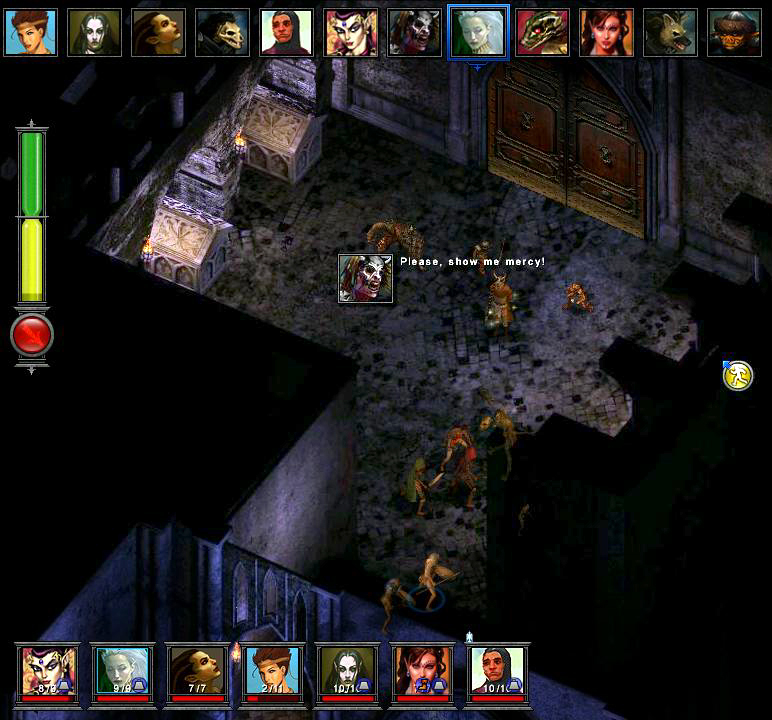
Other nice inclusions are such things as a druid's Reincarnation spell being mentioned as not being guaranteed to bring the character back as their original race, and the fact that paladins can fall from grace due to their actions.  Fallen paladins must seek atonement, which is prohibitively expensive to discourage casual out-of-character behaviour.  However, my paladin fell from grace unexpectedly when I spared the drow priest when he begged for mercy, and accepted his offer to escort me to a back entrance of the Temple of Elemental Evil.  It was not adequately telegraphed that this would entail the chaotic evil drow joining my party.  My solution was to kick the paladin out of the party and roll up a dwarven fighter.

Also nice is the inclusion of nonlethal damage in addition to the normal sort.  Things like fistfights and drinking contests involve nonlethal damage on a separate health bar.  When your nonlethal hit points run out, you fall unconscious.  This provides an alternate way of dealing with trolls, incidentally, who can normally only be hurt with fire or acid damage.  Everything else deals nonlethal damage for them, but the interesting thing is that once they fall unconscious, you can choose a coup de grace attack which kills them instantly.

I also appreciated the pop-up boxes of DM-text that appear when you enter significant new areas, describing the area to set the mood, much as a dungeon master would do in a pen & paper game.

The crafting menu has its pros and cons.  On the pro side, it gives you a full list of crafting recipes, and shows you what is required to craft them, such as level, spell, items, gold, and XP cost for Craft Wondrous Items.  You can easily add effects to items with Craft Magic Arms and Armour, and rename your items.  On the minus side, it's sometimes unclear why some of the effects can't be added (it doesn't tell you which condition isn't met), and many of the wondrous items are missing descriptions, or have inadequate descriptions, so I can't tell what they're supposed to do!  The game manual is excellent and extensive, but doesn't include descriptions of these wondrous items either.  I have to look them up in the online d20 System Reference Document to find out.

Speaking of recipes, this is the second Troika game I've seen that includes an actual food recipe in the manual, at the end.  Arcanum has "Grandma Cookhill's Three Bowl Bread", a halfling's banana bread.  This one has a recipe for "Chocolate Chip Cookies of the Gods", whose description indicates it also probably came from a halfling, though it was stolen by an orc.  I especially like the bit where it stresses the importance of waiting for the dough to chill thoroughly, saying "If you cannot wait, do not expect cookies of the gods."

Bugs

I've heard that the game was very buggy when it was released, as per usual for a Troika game.  The Circle of 8 mod pack appears to have fixed most of those bugs, and provided workarounds for most of the few that remained.  I only encountered three, myself.

One was when one of my characters walked across the Spike Growth I had cast, and acquired it as a permanent effect.  Even after resting more than 24 hours and performing heals on her, she still had the debuff, and the timer countdown never changed.  Periodically she would get hit as if she were still walking across the spikes.  I found this addressed in the Co8 guide, which said to go to the druid Jaroo in Hommlet, and ask to be healed of permanent spell effects.  This fixed the problem.

Another bug was inside the moathouse dungeon.  When fighting the big crowd of fighters, I ran into a game-breaking problem where there were two foes that didn't seem to actually exist, but they were in the queue for combat turns.  The game paused for a while when reaching one of them, and moved on to the next one, but it just never recovered from the second one, leaving me stuck in combat forever.  I tried fixing it with some console commands, which seemed like it might help at first, but just led to more problems.  I reloaded to a save before fighting the group, and tried again, and this time there was no trouble.

Lastly, there was a game-breaking bug on exiting the Welcome Wench tavern in South Hommlet, in which the party (and all NPCs) would be frozen once we got outside.  Effects like smoke from chimneys still functioned, and I could toggle in and out of combat, but none of us could move.  This bug occured twice from that saved game (when I did the same thing both times).  I evaded it somehow when I instead did a tavern brawl quest and then rested some more before leaving the tavern.  The Co8 guide says that freezes like this become more common in South Hommlet as the game progresses, and that players should avoid that area when possible.  I got through the rest of the game without any more such freezes, though, although there were other, unrelated freezes that were fortunately temporary in some places.

Storm of Zehir inspiration

I noticed that there were some elements in this game that I also noticed in the later-released Storm of Zehir, the NWN2 expansion.  One was the use of the Survival skill allowing the party to detect and avoid random encounters on the overland map.

Sometimes there were friendly encounters, such as when I encountered messengers who wanted to reward me for rescuing some of the people I found in the titular Temple of Elemental Evil, and sometimes there were encounters which were ambiguous.  One of them listed the encounter participants as "a party of adventurers", with their names and portraits in the list, so I was curious enough to hail them.  Sure enough, it was just a party of adventurers like mine, who at first mistook us for "another bandit encounter", to comedic effect.

There were some others like that, and it's nice when a game that includes random encounters takes the care to make them diverse, and not all about combat.

Speaking of which, it was interesting how sociable the denizens of the temple were.  Although the majority of monsters attacked us on sight, there was a significant number of characters who were willing to negotiate, join up with me, or allow to join up with their factions.  Some even offered quests!  There were numerous factions within the temple, working against each other even as they seemed to be working toward a common goal.

End game

The game got much, much easier as I gained levels and added enchantments to my weapons and armour with crafting.  I noticed that my dwarven fighter tended to score a lot more hits than my human barbarian, who missed against higher level enemies much more frequently, despite having near-identical enchantments and appropriate weapon focuses.  Encounters were almost always of the "tank & spank" variety, except that in this case, this tank was also the one dishing out the most damage.

There were two really tough fights, though.  Well, only one was really tough (others, like the group of beholder-kin on the ice plane and the group of fireball-flinging noble salamanders on the fire plane were tough, but not really tough), and that was the Balor on the fire plane (the D&D equivalent of the Balrog from LotR).  I had to retry that fight maybe 10 times, and most of the fights ended with the Balor having taken no damage at all.  By contrast, Zuggtmoy was only average!

I even sought tips online for beating the Balor, but they mostly didn't work with the Co8 mod.  Several posts recommended using Cloudkill against him, but when I tried it, it said "Target is immune!" so I guess the Co8 team figured the Balor wasn't hard enough.

Summoning the bosses from the other elemental nodes didn't seem to help either, aside from providing more targets to distract the boss.  More often than not, these summons cast AoE effects that resulted in friendly fire, dispelling my buffs, sickening my fighters, causing my party members to flee in terror, etc.

The fear was the biggest problem.  I read that "circle of protection against evil" is supposed to make party members immune to fear, but it didn't.  They were all within the protective circle, and they all ran away.  I had a bit better luck with the individual (non-circle) "protection from evil" spell, though, and I think that was instrumental to my eventual victory.  My fighter resisted fear the entire time, though my barbarian succumbed a couple of times, and had a problem with missing the enemy.  Regardless, the rest of my party (who were mostly useless against the Balor except to help cast buffs) dealt with the trash spawns while my dwarven fighter steadily whittled down the Balor's HP until finally, finally, it was dead.  After that, I went to face Zuggtmoy.

As stated, Zuggtmoy was much easier than the Balor, though I thought the rendering of her character was beautiful, as was the surrounding area of the lower temple.  Again, it was mainly my fighter who beat her up, while the others dealt with buffs and summons (and fear).  Great Cleave and weapons of Mighty Cleaving were a great help against these spawns.  Hasted, my fighter dealt four attacks each turn, at around 25 HP each, when she didn't miss.

Zuggy interrupted the fight at some point to try to make a deal, and I took my time in answering, but while I was considering it, I was surprised when one of the spawns started moving again, and the dialogue box disappeared before I had a chance to choose anything!  I wasn't going to make any deal, but I still wanted to see what she had to say about it.

This level of the temple has many rooms, but is empty except for one room of mushrooms.  Word has it that Troika ran out of time and couldn't put any of the encounters in that location that they had planned.  I haven't seen the original P&P module, so I don't know what was supposed to be there.  I'm surprised the Co8 pack didn't put anything in there.

Co8 does hold off the game from ending with the death of Zuggtmoy, so that you can go on to play some higher-level content in a new town.  I haven't done that yet, but I will eventually.  To end the game with the Co8 mod, you have to choose it specifically from the dialogue of Brother Smyth, so I went and did that to see the ending slides that I would have seen after killing Zuggtmoy originally.  The ending slides were better done than the ones in the NWN2 OC -- I can say that much.

Conclusion

The game is intimidating to a new player, and very tough and unforgiving at low levels.  It also includes many pre-generated characters with poorly-assigned ability scores for their classes, which can cripple a player unfamiliar with the rules.  Its art design is adequate, but bland, at least until you get to the Temple, and also very dark, requiring me to turn up the gamma to see.  It could have been improved with a larger number of interesting characters and interactions, because the ones that were there were quite fun.

Despite this, once I got through the first few levels, I found it to be an extremely fun game with rewarding challenges, plenty of quests, and a variety of environment styles.  Once I started playing it, I didn't play any other games until I finished it.  I think it's the best turn-based RPG engine available, despite the non-optimal interface.

Extra screenshot gallery

Tuesday, June 19, 2012

Step by step landscape

Here's a little post showing me sculpting a landscape in the Neverwinter Nights 2 toolset for my upcoming module, just for anyone curious about the process.

Here's how it started. I took the flat plane, filled it with a sand texture (for the ocean floor), and sank most of it so that it left only a little island in the middle, and a mainland on one side. I put a tower and an NPC on it for scale reference. Then I added a water plane, laid down a little blue tint for later, and started smoothing the island. I caught some of this on video, due to an unintentional Fraps activation, so here it is:

I continued adjusting the height and basic shape of the island until it was approximately roughed out to the right size and shape. Next, I started going over it again with a smaller brush for finer control.

Here, I started picking textures for the island and laying them on. Once I had the basic areas sketched on, I used the texture swapper to try different combinations of rock, dirt, and grass, until I found a combination that looked pretty good together.

After that, I added rocks, grass, trees, and bushes, as well as a dock and some rowboats. I adjusted the water and atmospherics too. Here's a brief video showing the island at this stage:

Then I threw on some textures for the mainland. Since this is off in the distance and shrouded in fog, it's not important to have fine detail, so I used camouflage-style large blobs of colour.

And here's a screenshot of the mainland from the lighthouse island.

Tuesday, June 5, 2012

New NWN2 module underway

I've officially begun work on the module I've been planning. I'm calling it The Black Scourge of Candle Cove, and I'm discussing my progress on it in threads on the NW Nexus and the Bioware Social Network.

Sunday, May 6, 2012

Quest indicator mod additions

I think this system is as developed as it needs to be to use it in my NWN2 adventure module, but there is one thing that only recently occurred to me to try that might make it that much more convenient to use. It's pretty convenient already, though, since I've gone through and made it all generalised to the point where you don't have to touch the scripts once you attach them to the appropriate location on your NPCs or objects.

Instead, you assign local variables to your placed instances, and modify them through conversations or by firing scripts on conditional actions, such as "On Enter", "On Inventory Disturbed", "On Death", etc. In other words, anything that triggers a journal update will just need to have this script fired too. Everything else is handled through local variables.

This way, you can also have one questgiver begin the quest, and a second questgiver finish it, which is very important for certain kinds of quests (like breadcrumb quests). Anyway, I've been documenting how to use it in detail.

The video also shows my modification of the dialogue panel from my HD UI mod.

I'm close to getting ready to start on the adventure module itself. I just want to play the game a little bit more first, but I'm really getting anxious to start.

Wednesday, April 4, 2012

Neverwinter Nights 2: Dark Waters, chapter 1

A few days ago, I started playing Dark Waters, a module in 3 chapters for Neverwinter Nights 2 by Adam Miller. It was one of the ones that has been in my priority queue since I started playing NWN2 and heard much about it, but I chose now to play it because I'm planning to have some ocean material in my own upcoming module, and I wanted to make sure I wasn't unknowingly rehashing old ground.

"Set sail on the high seas for this grand piratey adventure. From humor to horror this epic story spans dozens of islands, contains new powers and weapons, and countless voice actors. Grab your flintlock and raise your Jolly Roger today!"

--description of Dark Waters on its download page

Even before I got started, though, I had read an interview with Adam Miller, and he said that the nautical theme doesn't really show up until after the first chapter. Still, I expected there would be some in the first chapter, considering the title and the above description. Unfortunately, the entire first chapter (aside from the intro and the flashbacks) took place inside a mountain "clanhome", which seems to be the kind of undermountain city I tend to associate with dwarves, and tells the story of some youths growing up in a tiny village in the aftermath of some kind of war between the psionically "Gifted" and the "Normals" -- a war that left the world's ocean level permanently risen, with only the mountains remaining, as islands in the global ocean.

Following are my thoughts that I wrote out as I was playing through the module, with all the ups and downs and changes of opinion left intact.

The beginning

So far this is the most unconventional module I've played yet. It appears to be told in an omniscient narrative, because the point of view is constantly changing. I've barely had 5 minutes of free roaming gameplay, with the rest made up of jumping around into different characters' heads and roleplaying their parts in conversations. And just when I thought it had basically settled into a cast of characters, I was suddenly sent into a dream vision, in which I took the role of yet another character in another group of strangers!


Roleplaying one of my companions' parts

Once my party of three got into the mysterious sealed complex, though, everything got much more interesting. The story seems to have stablised, as well. No more jumping around from character to character. Now, the backstory is unfolding gradually through notes and museum plaques, and I'm being introduced to some of the interesting features of this module. First is the gem socket system, which I think is a substitute for the enchanting/crafting system in the vanilla game. The other is a nice little achievement tracking panel which displays various accomplishments and statistics.

The banter between the characters is also fun, and well-written. It's not only well-written in terms of believable and enjoyable dialogue, but it has proper spelling and punctuation, as well!

Throughout the module, you can also have chats with your companions. They have different things to say as the story progresses.

Beginning forgiven

Once the story progressed to the "war" flashback, the purpose of the flashbacks became clear. This is a kind of reincarnation story. It's a good one, too. I can forgive the rocky start now, though it would have benefited mightily from better pacing in that area. We players should have been given more time to play as this set of characters to ground us before introducing the flashbacks.

There was a "ghost" level, which reminded me of some of the good parts in Thief: Deadly Shadows (notably the note from Widow Moira, and the ghost of Laurel). It loses some points, however, for being dark. There were no lights, and it was a very large level with a lot of running around without my companions. My candle, when I tried equipping it, cast no light. I don't know if it was burnt out from all the use in the previous level where it did work, or if there was something specific to this level that was preventing it from working, but it was annoying. It is my position that function must take precedence over form when it comes to playing a game. That means being able to see, even if in the real world, a place would be pitch black.

It's possible that the game expects me to be able to use one of the two Gems of the Morning to provide light, since that is one of their properties, but that property only works on weapons, and as a druid, I had not yet found any weapons with gem sockets that I was capable of wielding. (I found a socketed dagger after this part.) Fortunately, as a druid, I did have the light cantrip, and resting was permitted, so I was able to keep casting that spell, and resting every time I ran out of uses.

Eventually, I was reunited with the party, power was restored, and I found two weapons that various party members could use to generate light. When it rains, it pours.

I think these levels could have been a lot smaller. As it stands, it felt a bit artificially padded out due to the size of the maps compared to the running speed. I noticed many rooms were very sparsely furnished, and occasionally completely unfurnished. Exploration seems to have been the intended design of this place, and a reduction in scale would have made that exploration more enjoyable.

Puzzles

Scattered throughout this module are unique gameplay elements, especially in the puzzles, though some others seem to have been included just as novelties, with no clear purpose in the game itself (such as the magic hockey game). One of the puzzles made no sense to me (the one needed to turn on the fan), but an alternative was kindly provided to bypass it.

Another of the puzzles was frustratingly designed -- the combination lock based on a girl's birthday. First of all, it was unclear which date-writing format the author was using (was the year at the beginning, or at the end?) I couldn't tell, since the numbers were 1 and 2 digits, and I have no idea in what year system this story was supposed to be set anyway. It was especially frustrating, since one of the numbers was a single digit on one side, but it expected a leading zero on the other part of the answer. I conclude that puzzles are quite a risk to include in a module, since the potential frustrations are rather high compared to the potential player delight. I don't think I'll include any puzzles in my module.

I did like the crafting of molotov cocktails, though.

Puzzles again

Well, once again this module has made me change my mind. It turns out that the next level was almost all puzzles, and it was the most fun section yet. The choice of music contributed to the sense of fun, as well.

The party was greeted at the stairs by a phantom academy proctor, who explained that he (and the ghost girl from the previous level) were bound to the earth as ghosts by the main character's prior incarnation, as a favour. At the base of the stairs was also a dead body carrying a gem that acted as an academic record, presenting me with the goals for the level -- pass a series of exams. Now, why my character would hang around playing these mini-games and working on the exams was a question I couldn't answer. I just assumed it was a prerequisite for advancing through the game. I eventually learned that I was correct, but I didn't get that confirmation until after I had finished all of the exams and made my way toward the exit. I think the proctor should have made some reference to the exit being off-limits to anyone who hadn't passed the exams when he appeared at the beginning of the level.

This was also the first level outside of the flashback sequences that had any substantial combat. A good thing, too, since combat is rather tedious at level 1, and the party had just reached level 2 before this section of the game. As has been the case throughout, gear continued to be slowly doled out, until most of us were comfortably outfitted. I'm glad to say that the combat was provided in small, manageable chunks between going from mini-game to mini-game.

Some of these mini-games were fun in their own right, like the dice game, and I wanted to play them more than once, but the proctor usually told me that I didn't need to do it again since I'd already passed. There was one instance where I actually had the option to go again, "just for fun", and that was the tank battle.

The climax and end

After the puzzle level, there was an underwater level in a flooded room that required breath management, and then an even more massive level to explore than the previous ones. This one was broken up into several sections, all radiating out from the ultimate destination in the centre of the complex. Here, there were yet more new gameplay mechanics to try, in the form of psionic power crystals that temporarily allowed my characters to cast some spell-like abilities. It seemed to be little more than a novelty, though, because the crystals only lasted a few minutes before disappearing, whether I used them or not.

There was a strange, unexplained item as well -- a focus crystal that allowed me to summon the ghost of Lucy, the little girl from earlier. I tried it several times, in many locations, but the result was always the same. She would appear, say "Hi!" and wave, and then stand there for a few seconds before disappearing again. I wasn't able to talk to her or anything. I thought maybe if I summoned her in a special location, it might open up a special dialogue or event, but it never happened.

Another unexplained mystery involved one of my party members. On entering a particular room, I think on the same level, Daniel disappeared from the party after a brief fade to black. When he reappeared, he was not in the party, and when I talked to him, it said "Daniel simply smiles". After visiting another room, I came back to that hallway and found his dead body, which didn't respond to anything. Ultimately, he returned, good as new, with nothing to say on the matter.

There was also the matter of locked doors. The game addresses the frequent use of locked doors, but there were some that I was never able to open. It's possible that I was meant to go back throughout the earlier levels with the late-added party member who seems to have a talent for opening secret doors, but I really didn't want to run through those massive levels yet another time.

I have to say I didn't like the bit where I had to take control of a lizardman to open a door from the other side. It seemed like I was supposed to sneak through it with stealth, but the enemies always detected me. I had to fight through a large number of enemies on that side, who regarded me as hostile even though I was one of their own, and every time I died, whatever weapons I had picked up to fight with disappeared. I was eventually reduced to a tedious series of kamikaze attacks, trying to get in at least one bare-handed attack before I was killed in one strike and had to respawn. This was probably the worst part of the whole module.

The final showdown was well done. The enemies seemed fairly organised and fought intelligently. One shortcoming was that the "villain" of the final big confrontation was a bit...vague. Although we started getting hints and information about him early on, the information came from an unreliable source, and I wasn't sure he was the villain at all. We also never actually saw him or any hint of his presence until that final confrontation.

Epilogue

It all ended with a very nice epilogue, with the party members saying farewell to their families and going off on an ocean adventure, where the second chapter of the series will pick up. I wish more games ended this well. Some stories (such as my earlier reviewed Witch's Wake) just end with poor cliffhangers, leaving everything unresolved, or ending with more questions than answers. I hate those endings. This module did it in the best way -- a solid ending, with the primary conflicts resolved, with the beginnings of what is clearly the start of a new story showing up as a preview. The old friends set off to follow the map onto the wide open seas, unsure of what they would find there. It was a bittersweet ending, full of regrets for things lost, and uncertainty of what was gained, but with the promise of each others' company along the way.

Not to mention an optional final joke. Self-aware jokes like this are scattered throughout the dialogue, and I personally appreciate them.

What few bugs I encountered weren't major, though the game did crash a scant few times while playing it. There was a very minor bug during a dream sequence, in which my normal PC was present on the level and selectable in the portrait list. She was stuck in a no-walk zone, though, so there was no trouble with her accompanying me where she shouldn't have been. The bit with Daniel's mysterious smile may have been a bug as well.

Since I'm running the full campaign, it transitioned seamlessly into the second chapter, but I stopped and saved at the beginning of that for now. It's looking very exciting, though, and it seems to go fully into the nautical theme I was expecting at the beginning. According to the journal entry, I can expect a very developed seafaring system, complete with trading and tactical ship-to-ship combat with ship upgrades and strategy, sounding very much like the systems in Patrician 3. This should be fun!

Friday, March 16, 2012

More NWN2 modding

I decided some time ago that I would make an adventure module for Neverwinter Nights, after my earlier Dragon Age: Origins quest mod experiment. I just can't really start on it until I have a decent-sized block of time I can spend on it, and I expect that will be this summer. In the meantime, I've been tinkering, reading the forums, and browsing the Vault's script repository, to determine what can be done in this toolset. From that, I'll decide what will be done.

For my first venture in NWN2 questmaking, I elected to begin with something relatively limited in scope. Any first work with a new set of tools should be small, in my opinion. As a learning experience, a smaller scope can prevent constant revisionism as one's skill and experience grows, by enabling the project to be completed quickly enough that such desires don't have time to develop.

That said, I intend for this to be the kind of module that I myself enjoy playing, and I'll judge my success or failure by how well I accomplish this.

Trouble In Rainesfere took two weeks to complete, not counting the viewing of the toolset tutorial videos that inspired me to create it in the first place. As with that module, I'll document my experience of learning the toolset and making a module, from my perspective as a beginner, which I hope will serve to inspire other beginners to give it a try if they haven't already. I'll allocate 3 weeks for this one, plus another week's worth of research and contingency time interspersed within.

This should be more than enough time, since, unlike with TiR, I will not be designing all of the areas myself. Having browsed through many of the prefab areas designed by other NWN2 players and modders, I was impressed with all of the fine quality work available, waiting to be used by other builders in modules. I don't know which ones have or haven't yet seen such use, but I can certainly do my part to showcase a few. It will save me some time as well, even though landscape design is one of the parts of modding that I find most enjoyable.

In addition, I've opted to adapt a pen & paper module for this project, which will save me some time in creating a design document. It's rather bare bones, and doesn't even include any sample conversations, or NPC builds aside from the main antagonists, so it'll require a bit of embellishment. My aim is to include everything described within, with encounters that have multiple approaches based on player choice and party skills.

Other mods in the meantime

Before I get into that module, I'm just taking whatever free time I can spare and feeling my way around the toolset and the game files, and making some minor cosmetic mods like some "beautiful people" heads for a few of the races, including humans, elves (including drow), half-elves, and halflings. The drow still needs some work in the eyebrows. I had some trouble with the specular maps, but got them to behave well enough.

I just finished something else, though, which I had been wanting to try for a long time in various games. After playing around with some visual effect mods, I had a basis for understanding how to use the Visual Effect Editor. So, after determining that it should be possible, I hacked together the parts I needed to create a DA:O/WoW-style system of quest indicators for NPCs, to make it easy to see at a glance whether someone has a quest available, and whether the conditions have been satisfied to complete it. Such indicators are especially useful in cases where an NPC may not have anything to say until certain conditions are met, or when an NPC you've spoken to before may have something else to say later, which you might miss if you have no reason to think the NPC has something new to say.

I know some people don't like visual gameplay elements in the 3D world for various reasons, but I intend my module to be an enjoyable game, and not an immersive cinematic experience. My module will contain no voiced dialogue, and what few cutscenes I plan to employ will be brief and for the purpose of calling attention to important events or points of interest during the gameplay. Cutscenes take control away from the player, and thus should be employed as minimally as possible.

In the NWN2 OC, they tended to use triggers to ensure that the player didn't miss some available conversation. If you walked anywhere near the NPC, your main character would be forced into conversation or a cutscene. I didn't like that. It was especially egregious during one time in the courtyard of Crossroad Keep when I was trying to walk over to the boy so he could teleport me out to the world map marker, and I was instead intercepted by the Luskan ambassador, and Sand brushed him off and force-teleported me inside the keep, where I didn't want to go!

I'm also going to try to find a way to make the game allow you to attack enemies before they become hostile. I hate those situations where you spot your mortal enemy from afar, but are unable to make a preemptive strike against him because the game requires you to walk up and talk to him first.

Anyway, I made the icons and the associated FX files on that first day. I wanted to make a little test quest just to try out and demonstrate the indicators, but of the quest wizard plugins on the Vault, two were database-dependent for persistent worlds, and the other was compiled for a previous version of the toolset. I don't know why plugins broke every time the toolset was updated, but most of them were dutifully recompiled until the final patch. Quest Maker was one of the ones that wasn't. Fortunately enough, the author provided the source code.

I had never touched anything like Visual C# Studio, but if I wanted to compile this plugin so I could try it out, I had to learn. A tutorial informed me that the necessary tools were free, so I installed the software and did everything it said to do, though some bits were harder to follow since the program had different names and locations for commands than the tutorial said.

I had to do some troubleshooting, since I told it to compile the DLL directly into the toolset's plugin folder. This caused the toolset to crash on open, and the reason seemed to be that it had placed a lot of unnecessary files in there. I cleaned them out and recompiled elsewhere, and dropped only the DLL into the plugin folder. It still didn't work!

Finally, my search led me to a forum post, where Marshall of the Legends Plugins had encountered the same problem, and most importantly, where he had reported how he solved the problem. The answer was that it had to be compiled for VB 3.5 instead of the default 4.0. This time it worked. Thanks, Marshall!

Quest indicator success

The next day, I spent maybe 6 hours figuring out how to get the quest indicator system working, and writing a quest to demonstrate it.

I'm still very much working in the dark with this script, and my hacks involve a great deal of trial and error. Getting the exclamation point to appear over the NPC's head was the easier task. Getting it to go away when I wanted to change it to a question mark or remove it entirely was the part that took many hours. I searched through tutorials, reference works, and forum posts, and tried three or four different functions, and changed variables and coding structure, all to no avail.

Additionally, the QuestMaker plugin I compiled yesterday seemed to only work partially. Possibly I did something wrong when I used it. I used it to create an "explore an area" quest so I could easily test the indicator system, but for some reason it didn't actually create the trigger with the code that would advance the quest, so I had to figure out how to script a trigger. I tried using the generic one and applied some variables to the instance, but I apparently did it wrong. I ended up trying out LilacSoul's Script Generator for the first time, and that succeeded. I really wish Marshall's Legends Quest Plugin worked for single-player modules.

Finally, I found a forum post that mentioned a function that I hadn't tried, and that successfully removed the effect from the NPC. Finally, it worked.

The code's not pretty, and it needs a little more work to generalise it, but I can use it in my module as it is now.

A bit more on my choice of quest indicators: It's much like the difference between making every barrel in the city lootable, with most of them empty, or having the barrels with contents stand out from the others somehow (such as by not allowing the empty ones to be opened). This is all about determining who is important to talk to, and who is only there as decoration.

I consulted some friends about their preferences in this regard, and got a reasonable range of responses. One was mildly against them, but thought it would be fine to use them the way I have in mind -- solely to mark the questgiving NPCs, and not to point out anything quest-related on the map. Two were okay with them, as long as they could turn them off, which I should be able to code.

Others were more positive and enthusiastic about them. One brought up how they would have been nice to have in Mass Effect, notably in the between-mission "party camp" on board the Normandy. With the party members being spread out between several decks, and knowing that they would have new things to say on occasions throughout the story, players like them (and me) got tired of running back and forth through the ship and up and down the decks to check each party member, only to get told over and over that they're too busy to chat because they're in the middle of some calibrations.

I've heard other systems proposed, as well. Questgiving NPCs could be distinguished by giving them occasional text barks or gestures to beckon the player to them. I like this idea as well, but I don't think it would work very well in a city environment with a lot of unimportant NPCs walking around, who I also want to have text barks to liven up the place. Of course, I've heard some players don't like text barks at all, and insist it ruins the immersion to see text floating over characters' heads, but all I can say to that is that those players will not enjoy my module.

Questgivers could be the only ones with proper names, with everyone else having names like "Commoner" or "Townsperson". That could work fine, too. I don't prefer it, though, because I don't know of any ways to make NPC names always be visible, rather than having to mouse over them to see the names. I would actually like to have visible names in addition to the quest indicators.

Other, more minor visual indicators are things like having questgivers dress in brighter colours, or wear a special badge or piece of gear, or have them emit a subtle glow, or even have all questgivers share a single appearance!

In any case, I like the exclamation point solution best. Personally, it delights me to walk into a new area and see lots of new quests for me to accept, and I think nothing does that better than the exclamation point!

This of course opens the door to a wider range of visual indicators, such as for merchants, healers, or innkeepers, but I don't know if I want to take it further than just questgivers. Those NPCs tend to be easy enough to recognise as long as they're located in logical locations (such as in a shop, in a temple, or behind a bar), and it would probably be enough just to have their names indicate their role.