Showing posts with label lore. Show all posts

Wednesday, August 29, 2012

The Privation of WoW

Since the Starter Edition came out for World of Warcraft, being an unlimited free trial with a cap of level 20, I occasionally drop in and play the post-cataclysm low-level quest content that was all new to me, or try different races and classes.

I typed up all my experiences and impressions of that content, but never finished the article or uploaded it here. The basic summary is that they had stripped the gameplay and the leveling experience of at least half of its previous depth. Perhaps in the future I'll explain why I feel that way.

Now, with the new expansion Mists of Pandaria, Blizzard opened up the goblin and worgen playable races to the Starter Edition, enabling me to create a new character of each of those races and experience their unique 1-10 leveling zones.

In so doing, however, despite the new (to me) content to experience, I found that they've removed even more gameplay, depth, and immersion from the game.

At one time, you got to know your choice of class through interactions with your class trainer and class-specific quests, which provided a grounding in what it means to be whatever class you chose. New abilities were given as rewards for going through certain rituals or rites of passage, and class quests would send you out to assemble unique items perfectly suited to your class, which taught you what kind of gear you should be looking for in the future, though these class quest rewards were often so good, you'd be using them for the next 10 levels before you could find anything better.

In general, class quests were integrated into the questing experience at least all the way up to level 55 (pretty much the end of the vanilla game), when every class was funneled into the Sunken Temple for their class quests, so really, you could go through the entire game and experience new content all the way through just by picking a different class. They really made classes feel distinct and interesting, with plenty of backstory.

Cataclysm removed most of the class quests. What previously was a reward for a chain of interesting quests was turned into something you just pay to learn at a trainer. If you didn't play it before, you'll never experience the flavour that used to give it meaning.

They also removed most of the class-specific items. Warlocks don't really need soul shards anymore. Hunters don't need ammunition or pet food. Rogues don't need to brew their own poisons.

Okay, so that's all just a little summary of a couple of the small things that were changed in Cataclysm (instead of the long unfinished article on that and many other things), as a lead-up to what I've just experienced in the changes brought by Mists of Pandaria.

The biggest thing is that now, in MoP, they give you all your class abilities automatically, for free, with no training. Trainers are now nothing more than providers of basic information and respecs. The last tenuous connection to that old sense of involvement in the game world is now broken. I no longer feel like I'm a part of something, at all.

Moreover, what was previously a gold sink is now gone. What am I supposed to do with all this gold, now that I don't have to pay for talents or class-related materials?

Really, the only vestige of what class quests used to be is now only to be found in the repeatable quests for cooking and fishing. There are 5 randomly-assigned daily quests in each major city for each of those professions that send you off to do things related to that profession, with the quest text providing some feeling of being a cook or a fisher in that world, and giving quest rewards related to that profession. That's fun! And it's a shame the classes have had that sort of thing taken away from them.

Saturday, June 2, 2012

Neverwinter Nights 2, part 6 (ending)

Aside from some new upgrades being available to build at the keep, and some new keep-related resources to collect, the order of the day in Act 3 is to gather some potential allies for the upcoming fight against the King of Shadows (I agree with the Luskan ambassador in regard to the silliness of the name). Basically, that means that Crossroad Keep has become a new quest hub, with the world map now being restricted to locations that relate directly to this purpose. All except for the town of Ember, which has no one new to recruit. I went down the well to see if I could gain the friendly goblins as allies, but there was no new dialogue with them. There were also some characters available to recruit to work at Crossroad Keep, which don't seem to be directly related to the upcoming battle, like a dancer for the tavern and a couple of extra merchants.

The other locations (with one notable exception) were pretty small and self-contained, not like the similar ally-gaining quests in Dragon Age: origins, which had very large diversions for each one. In at least one case (Highcliff), it seemed like they might have planned them to be larger originally, because they involved some boss-level fights with groups, phases, and adds, but these were all located right there, without having to crawl through a dungeon to reach them.

The simplest of these was also the hardest. I had to fight a character named Light of Heavens in a one-on-one duel. Again, me as an unarmoured spellcaster, and her as an armoured sword-swinger with knockdowns, high hit points, and lots of spell resistance. Once again, with this fight, the devs show their disregard for clothies by requiring it to be a solo effort. This was a slightly laggy location, with dozens of citizens spawning from houses and evacuating the city, but not enough to interfere with the gameplay. It took several tries, but I finally beat her with the use of about 10 summoned creatures (in a series, since I could only have one at a time), 2 or 3 blast globes, just about all my spells, and lots of running around the marketplace in a big circle to gain enough distance to cast spells at her, since my speed was just slightly higher than hers. The process was basically starting with a summon, running away until it got her attention, then casting spells at her until she killed it (which didn't take long), then running away far enough to summon another creature before she reached me, then running some more until it got her attention, and so on.

The one in Highcliff where I had to fight a lizardman shaman king was a much better fight, and much more fun, but it was, again, right there in town.

The druid circle one involved two of the companions, Elanee and Bishop, which gave it more character, but I don't see why it needed Bishop there at all. He was a forced companion when I went to that area, but didn't seem to do or say anything that made his presence mandatory. This was a minor annoyance since I had stripped him of all his gear when I left him behind at the first opportunity, and when he showed up I didn't have any armour on hand that he could wear. I never gave back his dagger, either, because I have Neeshka using it. The only reason I can speculate that Bishop might have been required, since he didn't contribute any unique action, and his commentary was inconsequential, is that perhaps his having witnessed the events there might play a part in a later development. There was some conversation back at the Keep from an earlier plot development when Bishop made some comment about what "we" went through, even though he hadn't been in the party at that time. I don't trust this chaotic evil ranger, and I don't like the fact that he's making his home in my keep, away from the watchful eye of Duncan back at the Sunken Flagon.

The Alliance with the Wendersnaven bit finally addressed the bard issue I had mentioned earlier. Finally, I got a bard instrument (the only one in the game?) that actually boosted bard skills rather than yet another equippable item that does nothing but cast some low-level spells when activated. Finally, a gameplay reason for my bard to carry an instrument!

There was an encounter with the ghost of a dragon in a location revealed to me by Ammon Jerro, which was plot-related, but separate from the "recruitment" theme of the rest of them. The dragon had information about how to reforge the silver shards into the sword we needed to kill the King of Shadows (why it would work this time, when it didn't work the first time, is unclear.) Apparently, Ammon had spoken to this ghost several decades ago when he was researching where to find a weapon to fight the King of Shadows in the first place.

The dragon's ghost was chained to this area due to a giant floating crystal dragon heart being physically chained up in this location, guarded by a couple of smaller dragons. By the ghost's request, I fought those guardians and destroyed the heart to release the spirit. This led me to yet another return to West Harbour, and at least this time one of the companions expressed a little emotion over what happened there. Grobnar did, too.

The best quest in Act 3

The recruiting of the Ironfist clan was the most developed of this section. It's almost out of place compared to the other ones, but you won't hear me advocate scaling it back to match the others. This one had much more companion involvement, and its task actually took place in multiple locations, and brought back events from way back in the storyline, involving an artifact-level pair of gauntlets that we had found at that time, the Gloves of Ironfist.

But talking with other voiced members of Khelgar's clan made me notice that Khelgar's the only one of his clan with that "Scottish" accent! I seriously can't understand how production companies keep doing this sort of thing. It's like Deanna Troi being the only Betazoid with her accent (her mother doesn't have it, and her father was apparently American), or Ambassador Delenn being the only Minbari with hers, or Londo Mollari being the only Centauri with his. Khelgar might have been a required companion for this section (if not, he should have been), but I can't tell because he was already in my party, reclaiming his role as the party tank after the death of Shandra.

To gain the support of the dwarves, we had to prove to the clan that Khelgar was a member in good standing, and not an outsider who had deserted them. To do this, we had to recover the second of the clan's patriarch's artifacts: The Belt of Ironfist. With that and the matching gloves, Khelgar would have the augmented strength necessary to lift the Hammer of Ironfist, once wielded by King Loudram, in a kind of sword-in-the-stone test of worthiness.

The belt was in the possession of some fire giants, so it was off to Mount Galardrym to find them.

Mount Galardrym was the biggest outdoor area I've seen in the game, if I'm not mistaken, and it was the absolutely best designed area. The long, winding paths leading up the mountain, overlooking lava pits, were clearly crafted with love and care. There were numerous watchtowers with trapped approaches, guarded by groups of fire giants and hell hounds who were fun to fight (though perhaps too easy for giants). There were several points of interest and several separate destinations to reach. One spot offered a scouting overlook to any surviving giants that our party may have missed by taking alternate paths, and offered an opportunity to push some large rocks down onto their heads as a surprise attack.
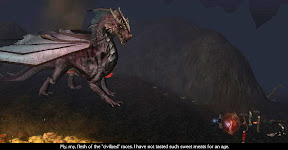
But the highlights of this area, aside from its aesthetics, were the two boss battles, one at the end of each path. One led to a big red dragon, and the other to the powerful fire giant king with his retinue of more giants and hell hounds than I had battled on the way up. Each of these bosses wanted the other one dead, as it happened, but I was not inclined to make any deals with either of them, so I fought each of them in turn. First the dragon, and then the giants.

The dragon fight was very challenging, and a lot of fun. My party was wiped on the first try. On the second try, I memorised a whole different set of spells in preparation, buffed nearly the whole party for immunity to fire damage (as many as I could with the spell slots available), and made sure all my offensive spells had significant damage even if save rolls were made. It was a brilliant light show! I've never had such an enjoyable dragon battle in any game before!

Contents of one of the chests showingAt the end of it, adding to the satisfaction of defeating a worthy opponent, the dragon's treasure hoard waited as a tantalising bonus. A huge pile of gold, and trapped chests filled with high-end gems, scrolls, and enchanted gear. This blew away the most recent other dragon battle I experienced, which was in Dragon Age: Origins (the dragon in the Brecilian Forest ruin, not the Archdemon). The fight there was less fun, and the hoard was much smaller. Here, I actually got to send my staff to haul the piles of gold back to my treasury! My standards had been lowered so far from previous games, I really wasn't expecting to be able to do that.

After I'd finished savouring my victory, I went around the mountain to the other side to face the fire giant king, which was another pretty good fight, but an anticlimax in comparison.

After gaining the Ironfist alliance, there were a few outdoor battles with the King of Shadows' forces, including a rather funny bit where we found part of his vampire army sleeping in their coffins during the day. Breaking the coffins open resulted in a crowd of vampires running around shrieking in the burning sun!

Ammon Jerro's remorse

I came to like the character of Ammon Jerro over the course of the game, despite the ruthlessness of his actions -- especially where it was completely gratuitous. Now, some of his murders were for revenge, though I don't recall if he explained what exactly their offenses had been against him. Other murders, however, were wanton and unnecessary, like the employees at the Moonstone Mask. While it turned out that he was motivated by the goal of recovering the shards to fight the King of Shadows and prevent a larger number of deaths, and considered some innocent casualties along the way to be acceptable losses, in some of these cases he could have just gotten what he came for and gotten out, without killing the people who were not fighters, and who were incapable of actually preventing him from getting the shards.

Spoiler: Click to display/hide

This hidden spoiler block contains spoilers about the death of a particular character

Solution to a major plot bug

There was a game-breaking bug in the battle at Crossroad Keep, after the siege tower battle, when Black Garius showed up and was giving his speech about how he was about to crush us by summoning an avatar of the King of Shadows, but it was actually pretty funny when it happened. In the middle of his speech, he apparently wandered a little too close to one of the soldiers, who sucker-punched him. This cut off his speech and he started fighting the soldiers, and never got around to summoning the avatar. Unfortunately, he was also plot-immortal at this time, so the game couldn't continue.

The solution is to open up the console and type:

rs 3541_death_nwalker

This loads up the cutscene that should play after you kill the King of Shadows' avatar, and the plot can continue from there. You will miss out on actually getting to participate in that fight, however.

I was also proven right not to have trusted Bishop in this section, since he was the one who just unlocked the gate to let the enemy in after the siege battle.

The ending

The ending was quite the mixed bag, but I'm inclined to forgive the visible signs of the time/money running out. There were subtle signs before, throughout the campaign, such as the design of Highcliff (the "tavern" bit I mentioned in a previous post), some conversations with companions that never went anywhere, and the large difference in scale between the various alliance-gathering missions, but the first really obvious sign I noticed was when I was looking to see what there was to do in the merchant district in Neverwinter during the evacuation. There was a dead man near an outhouse named "Privy Man", who had a mysterious journal on him that described some fearsome beast under the outhouse. I looked around, but found nothing else to do with him, and when I looked for answers online, I learned that it was the remnant of some cut content -- the Archmage Startear would have sent you on a quest to kill a lich who lived under that outhouse.

Nevertheless, whatever else they cut, Obsidian at least made sure to deal with all of the named adversaries introduced throughout the campaign.

Things really started showing the time/budget strain when what I thought was going to be another major battle turned out to be me watching a slide show of retouched screenshots, with voice acting, of Lord Nasher leading his troops to battle, and then a major event in the battle, and its outcome. Surely this was originally at least meant to be a cinematic, if not something in which the player was meant to participate!

Then there was the ending scene itself, which came after the final dungeon. After defeating the King of Shadows (it shouldn't be a spoiler to know that such a thing is possible), I was treated to another very unsatisfying slideshow of retouched screenshots describing the immediate aftermath of the battle (more on that in a second), narrated by a clearly non-professional voice actor (who someone on Youtube described as "Norman, from Accounts"), which then went on to describe what happened with various people and places in the next few years.
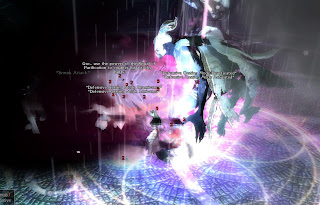
What happened directly after beating the boss, I was told by the narrator, was that my whole party was wiped out by the collapsing lair, because the King of Shadows was a "load-bearing boss". In other words: Rocks fall, everyone dies. I was incredulous. I couldn't believe that's how they ended it. And that was the good ending!

I spent the next few hours reading other people's reviews of that ending, as well as watching the "evil" ending on Youtube. Interestingly, while looking around on Youtube, I found that dialogue of my companions had actually been recorded to act out what I was only told had happened, and Youtube user RandonB put them together and posted the dialogue. I think that version of the ending would have been much better than the poorly narrated version, even if they had done it with the slide show method they had previously used for Lord Nasher's battle. It would have certainly been more poignant, as opposed to the whole "Then, offscreen, this happened. But never mind that -- here's what happened elsewhere over the next few years." Doing it the way they did, it actually reminded me a bit of Harry Potter and the Deathly Hollows (the final book in the series) in how the epilogue chose to answer questions that no one had even been asking, while keeping mute on issues of actual interest and relevance.

But aside from the actual ending, I enjoyed the climax very much. First was the showdown with Black Garius, and his attempts to seduce the members of my party to join his side, one by one. I actually went through this scene twice, because I wiped on the first attempt. The first time, he succeeded with Sand and Bishop (though Bishop had defected to his side earlier than in this scene), but the second time, he succeeded only with Sand. Although my influence with Bishop was predictably very low or nonexistent, considering I never included him in the party and didn't like him, and I hadn't said anything to try to convince him not to fight us, for some reason he decided to abandon both sides the second time through.

Neeshka was able to resist Garius' demon-binding on her through the power of friendship, since I liked her a lot and had a very high influence with her. I had high influence with everyone, really, except for Sand, who I neglected as much as Bishop, and much for the same reasons. So, with Khelgar, Neeshka, Grobnar, the Construct, Elanee, Qara, Casavir, Ammon Jerro, and Zhjaeve, we beat the stuffing out of Black Garius, at last, in a long battle with barriers, multiple add spawns, and several full heals on Garius' part. The rod of resurrection I was given earlier saw numerous uses during this fight. This battle also incidentally showed that it's possible to have a party of 10 fully-controllable characters, and that the previous party number limit had not been hard-coded.

After that mini-boss, it was time to face the King of Shadows himself, after a rest to heal and refresh our spells. It was nice of him to delay his passing through the portal until my party had rested from the Garius fight. This was a major fight, and with 10 party members, it resembled a raid boss. There were several phases to the fight, involving several strategies and objectives, and this made it particularly fun. It turned out that the Silver Sword of Gith was actually necessary after all to beat the KoS, but only because it was the only weapon that could damage the portal to the shadow weave, which is apparently the direct link KoS was relying on to stay alive (even though he had managed to forge a link to it out of nothing in years past, when he was dying, so it shouldn't have been any big deal for him to just make another one). Really, this whole climax was fantastic, right up until the slide show ending.

Obsidian bit off more than they could chew, but I prefer it that way. It was already a huge campaign with a massive amount of content, and I for one am glad that they aimed high, even if they ultimately had to abandon some of their plans.

And now that I've finally gotten the last part of this review posted, I can get started on my module.

Thursday, June 16, 2011

Baldur's Gate 2: Shadows of Amn, part 1

I think most people interested in reading this have probably already played the game, and are just curious to see someone else experiencing it for the first time, so for the most part I'm going to leave my spoilers unhidden. But first a brief hidden list of what I already know, since I had encountered a number of spoilers myself just from reading about this game series, I know that Sarevok somehow reappears in this game (even though he crumbled to dust last time I saw him), there's some kind of betrayal to expect from Yoshimo, there's a vampire named Bodhi, Irenicus is doing something that involves stealing souls, and that a couple of characters from BG1 have died offscreen between the last game and this one.

For BG2, I imported my character from the final save of BG1, but I realised too late that I hadn't been carrying the Golden Pantaloons that I had been advised to bring along, along with a few other items that are supposed to follow you into BG2. I did find the Helm of Balduran after all, though, which Minsc had been wearing. Oh well, I'm not going to worry about the pantaloons. From what I understand, all they did was eventually give you some cheat/god gear which I wouldn't use anyway.

I did have to make some edits to my character after importing her, though. Firstly I redistributed some of my stats using Shadowkeeper (no cheating either -- I removed as many points from some stats as I added to others) so that I'd have a decent amount of wisdom for the Wish spell. But even after reading up on stats for sorcerers, I'm confused about which stats are good for the class, if any. Later D&D editions say that charisma is the main stat for sorcerers, and that intelligence and wisdom do nothing (aside from the aforementioned Wish spell). But elsewhere I've read that charisma doesn't do anything for sorcerers in BG2, so I'm left thinking that sorcerers don't actually have a stat that affects their magic ability. I also went ahead and changed my name to a more classic fantasy name (after briefly experimenting with a comedy name which appears in most of these screenshots), and also picked a different voice set -- one of the few imported from Icewind Dale that worked (the sultry one). It's still Theseus' ship, right?

Next, the portraits. As much as I liked the cartoony style of the portraits I used for BG1, they didn't exist for all characters, and there just wasn't as much variety as there are for more realistic portraits, so I decided to go all-realistic this time. I changed almost all of the portraits. You can see some of the alternate portraits I'm using in that character record screenshot, a couple of which I collaged together myself. Minsc is the only one in my current party that remains unchanged. I don't really see any reason to change it, anyway, though it could benefit from better contrast and more colour saturation to better match the other custom portraits.

Finally, mods. I'm using quite a few mods, some of which are even new companion mods. Perhaps I should have opted to play it without extra companions the first time, but I have a feeling I'll be playing this game several times through anyway, so why not? I'll still keep at least half of my party occupied by default characters, and I'm sure if I don't like some of these new NPCs, I can uninstall them, thanks to WeiDU.

So, my installed mods are: Disable Startup Movies; Widescreen Mod v2.2; BG2 Fixpack; Banter Accelerator; NPC Flirt Pack; Unfinished Business; IEP Banters; Separate Avatars for Female Dwarves; Ascension v1.41; NPC Friendships; BG2 Tweaks.

And new NPCs: Allison, Alora, Auren Aseph, Chloe, Fade, Keto, Saerileth, Sarah, and Tashia. Alora is a recreation of my favourite thief from BG1, though I should really swap her out with someone else once I find another thief, since I'm currently without Imoen.

I also started with the Imoen Romance mod, but I quickly found it to be...unwelcome in my game, and uninstalled it before I reached the end of the dungeon.

"Just like old times! Well, except for the torture and all..."

Imoen showed up to join me, just like in Baldur's Gate 1, except she's a bit more shaken and disturbed by whatever torture Irenicus was putting her through. Probably something similar to what he'd been doing to me in the first cutscene, but the narrative suggests that my character doesn't remember any of it aside from that last interrupted one. Irenicus' monologue is a bit ambiguous about how much I'd gone through, since he says at the beginning "It is time for more experiments" (emphasis mine), and yet he also seems to be discovering my untapped power and potential for the first time. Possibly when he says "more" experiments, he's talking about the experiments that he's been doing on everyone else, and this is the first time he's started working on me.

Minsc and Jaheira were in cages in the same room, and they both hailed me automatically. Some of this seems like concessions to people who may not have played the first game, with all the dialogue explaining (if you claim not to remember) that they're old adventuring friends, and what happens with Minsc. It seems that no matter what you do or say, Minsc will take it to mean you're intending to abandon him, making him angry enough to go berserk and bend the bars open just so he can strangle you. He recovers quickly, though, and comes to the conclusion that you must have intentionally made him angry so as to get him out of the cage. This is a bit of a forced "choice" on Bioware's part, and I'm not sure why they thought it was necessary. There is an option to dismiss him from the group after this, but I didn't try it to see if he would actually leave or if he would refuse.

Jaheira's cage at least required a key. She said "If you're strong enough, maybe you can break it open", but even with Minsc in the party, I couldn't find any way to attack or bash the lock as you can in Planescape: Torment, and it was one of those "unconventional locks" that Imoen can't pick. The key was easy enough to find, and I freed her and invited her into my party. I didn't run with her in the first game, but that was mostly because I didn't like Khalid. Besides, even if Khalid were with her this time, it would be cruel to just leave her in the cage, and it would be stupid to not accept her into the currently shorthanded party once she's free.

While having Imoen scout ahead for traps (just like old times, if by "old" you mean "last year"!), there was an interesting but odd encounter with a genie named Attacker -- er, sorry, Aataqah -- who greeted Imoen by name, and seemed glad to see her. Interesting that the genie spoke directly to her, and expressed disappointment that I (the main character) wasn't around to talk to. Other times I've spoken with NPCs using someone other than the main character, the dialogue simply assumes that it's the main character talking, despite the name showing as the currently controlled character -- and sometimes that character will argue against herself with interjections!

Aataqah presented us with a hypothetical variation on the Prisoner's Dilemma, but he didn't seem to like my answer. His response indicated that he assumed my choice was for some other reasons than my actual ones, which is the same problem that plagues many so-called "personality tests" online, where intent and motivation are never considered. I liked Minsc's answer better, anyway.

Name pronunciations

I now know for certain how to pronounce the character's name "Khalid", since Jaheira's voiced dialogue includes her pronouncing it "ka-LEED". So far, I do not know how the name of our adversary Irenicus' name should be pronounced, but it reminds me of the name of the theologian Irenaeus of the Classical period. His name has a number of variations in English, but I'm partial to the ones that sound like "ear-uh-NAY-us" and "eye-ruh-NAY-us".

So, based on Irenaeus' name, I will assume, until/unless I hear it pronounced later in the game, that Irenicus' name should be pronounced "eye-ruh-NYE-cus", since it's the better-sounding of the possibilities.

The dungeon in general

Aside from quickly gathering more loot than my party can carry, I don't see why anyone would want to skip this dungeon. It actually seems pretty fast to go through, with a large variety in its décor, and some parts of it are entirely skippable, as I discovered by accident when I found myself outside without having used any of those trap-disarming rods I had picked up earlier. I had to reload to explore the other path (I had thought the side passage would lead me around into a control room or something) so that I wouldn't miss any of the content. I also almost entirely missed the elemental plane of air, as its doorway was not very well-distinguished from the rest of the walls around it. I probably would have missed it if not for it being marked on the map.

The encounter with the dryads was probably the most interesting part, as it seems to shed light on what's going on with Irenicus, and included some nice character development. They say that he brought them there because he wanted them to inspire emotion in him, and that he feels something missing. They also told a little about the (heavily trapped) bedroom of a woman of whom he seems to be mourning the loss. I'm guessing he trapped the room to ensure that no one disturbs the way she left it, and not because she usually preferred sleeping in a trapped room.

I'm assuming this is the same woman who was involved in the forgotten cloning experiment, in the room full of tanks containing partial and whole clones of one specific woman. That room, like many in this dungeon, was a tantalising tease, raising interesting questions and issues that I hope are foreshadowing for what's to come. Clones, vampires, and forgotten gods feature noticeably here, as well as portal travel to other planes.

I might even wonder if there was some significance to the library scene, where Imoen commented on the "dusty old tomes all over, bookcases nearly spilling..." Nearly? Books were piled up in, on, and around the bookcases, but strangely, the single desk in the room had nothing on it at all.

Earlier, I had found the room of tanks that were keeping some people alive, though most seem to have gone insane from the extended isolation. The one in the other room, Rielev, who could actually hear me and respond was the most effective in creating pity, and this is helped greatly by the voicing. He was a former servant of Irenicus, and Irenicus had been trying to find a way to cure whatever was killing him (or had killed him), and restore his youth, planning to give him immortality as a reward for his service, and keeping him alive in a tank in the meantime. But, like everyone else in that area, he had been forgotten, and was slowly going insane over an unknown number of years.

"Master! I no longer wish to come back! Let me slip into the oblivion that has been denied me! Please!"

Jaheira preached unwelcomely about how wrong and "unnatural" it is to try to preserve life, and unfortunately there was no "Shut up, Jaheira!" option. No one would want to keep enduring the situation he was in, but the problem was not that he was being kept alive; it was that he was being kept trapped in a small prison with no contact with other people. What if his tank could have been moved to the dryads' room? There, he at least would have had the company of three sympathetic creatures for as long as they were all trapped there. Regrettably, there seemed no obvious way for him to survive outside of the tank or to be moved, so death seemed to be the only option I was able to give him.

Doppelgangers again

Well, only one this time. A fat old man was imprisoned in a cell with glass windows instead of bars, and I went ahead and freed him, though I did think it was rather strange that his cell was outfitted with so much furniture, and containers that held pretty good weapons and gear. He insisted on tagging along with us to find the exit together, and I kept an eye on him.

I don't know if it was coincidental or intentionally scripted, but it turned out that he decided to drop his disguise and declare our stupidity at having fallen for his ruse at the same moment as the party encountered a group of hostile dwarves, but it worked out pretty well that it happened at that time. Jaheira had recently leveled up, and so I had just been reviewing her druid spells, and noted that she had a "charm person or mammal" spell memorised. I wasn't sure what a doppelganger qualified as (their hissing and their disdain for simians like us seems to suggest something vaguely reptilian), but I tried it out anyway.

It worked, and he was charmed, so I sent him into the group of dwarves to soften them up for a little while, before throwing a skull trap into the group, and cleaning up the weakened stragglers after that.

A nasty surprise on exiting the dungeon

So, my heavily-laden party finally emerged from Irenicus' dungeon, looking forward to selling off all the junk gear we could carry in the nearest town and to stock up on necessities. It actually took a lot less time than I was expecting, considering people have apparently found it too bothersome to keep running through on replays, judging from the existence of a popular mod that skips that part of the game. I was really expecting something more akin to the Circle Tower segment of Dragon Age: Origins, which I loved, but which was very long.

Anyway, in a scripted sequence, where my party is unable to act while events unfold, we see Irenicus fighting off the last of the invaders, and then he greets us before Imoen throws a magic missile at him. He responds with another spell (much less lethal than the ones he had just been using on the invaders), and then the bloody Ministry of Magic shows up and says they're both expelled from Hogwarts for their unauthorised use of magic!

So the result is that they took Imoen away to lock her and Irenicus up in Azkaban. I've lost one of my favourite characters, and I don't know how long it'll take to get her back. I hate that kind of plot twist! They did exactly the same thing in Planescape: Torment with Morte! Taking away a character from the party with me frozen in place unable to do anything but watch it happen.

Looking around, I found that we had actually emerged from the dungeon inside a major city. So...all this torture and hideous, Mengele-style experimentation was happening right under a busy marketplace? I'll have to see if they explain later how this had all been going on under the noses of the Cowled Wizards all these years.

So after selling off all the unnecessary loot in the many shops on Waukeen's Promenade (who all seem to sell nothing but weapons, armour, ammo, and other adventurer-centric items -- even the one in the fruit shop!), I learned that I could obtain a license to cast spells in the city if I go to the government district. As a sorcerer, I don't want to run into the same kind of trouble Imoen got into before I can rescue her. Strangely enough, I had actually cast Identify on a couple of items, and no one got angry. Maybe that one's not flashy enough to notice.

There seemed to be one major thing to do in that location other than buy/sell gear and rest up, and that was to investigate the trouble in the circus tent. And that's for another post.

Sunday, May 29, 2011

Planescape: Torment, part 3

During this early part of the game in the Hive, many people asked my name during conversations. This stopped happening after the Hive, but while it was going on, amongst the options like "I don't remember" or "None of your business," I was often given the option to offer the name "Adahn". I don't know why that name in particular was a given option, but for all I know it could have been a subconscious memory of my actual name coming to the surface. Another possibility is that Adahn is simply one of the more common names in that setting, and would do as well as any other name in giving the person something to call me. I chose that option once or twice for the sake of not making people suspicious of me, as my earlier self had advised (recall "do not tell anyone who you are or what happens to you"), though other times I went ahead and tried seeing what the truth would get me (which was always more questions).

I read that giving the name Adahn is counted by the game as a chaotic act for the purpose of shifting my alignment, but I don't see why it should be. Even if all lies are considered chaotic acts (even if it would cause more chaos to tell someone that I don't remember my own name), the fact remains that I don't know whether the name came to mind because it's a faint memory or if it's a convenient grab, though the fact that it's the only name ever given in the options makes me favour the possibility of a memory, in which case it's not a lie. Not to mention that if you consistently identify yourself to people by a particular name, then that is your name in a real sense.

Highlights of the Hive

There was an elderly woman at the memorial in this section of town who delivered a rant against adventurers like us. There were a couple of similar adventurer-related speeches in Baldur's Gate as well, but this one would have better been left for a bit later in the game, because she refers specifically to a peculiarity of this game in particular. The player wouldn't necessarily have had time to notice that the standard opening line in conversation is "Greetings". If she'd been encountered in a different section of the Hive, it would have been better in that regard, though since the reason for her rant was the death of a loved one, I can see why they located her nearby the memorial outside the Mortuary.

More importantly, there were two NPCs at the memorial who are involved in quests. One of them was near the group of professional mourners (all of whom were male, though in the real world, professional mourners are usually female) called Death-Of-Names, who carves the names of the dead into the giant mass tombstone, and never makes a mistake. The dialogue seemed to imply that in a place like Sigil, where belief often makes things real, that if I were to have him scribe the name of a living person into the stone, it might kill them. I never attempted that, so I'm not sure if it was an intended implication. Perhaps it only meant that he can sense whether a person is dead or not.

Nearby, a woman mourned for her sisters, and gave a quest to kill some members of the gang who killed them, though she didn't seem to care if they were the exact same ones. The gangsters are part of the Chaosmen faction, though, and are called "Starved Dog Barking Thugs", so the world would probably be better off without any of them, anyway.

The Post is a nice, unique element in this part of town, standing in front of the bar. It's actually a zombie, being used as a kind of advertising post (and not as a parcel delivery service as I had originally thought) that has apparently been enchanted to point in the direction of any of the businesses who have attached their advertisements to its body, if a person speaks the name of the business. At first it seemed like a simple novelty with no real relevance to anything, but after I pulled a vandal's thrown cobblestone out of its head, I found a graffito of the name "Pharod" -- the man my back tattoos told me to look for. Speaking his name made the Post point in the direction I had to go, which was a welcome bit of information. It was already clear by this time that it was a fruitless endeavour to walk around town asking people if they'd seen a journal or knew where to find Pharod.

I'm not sure if the name was actually under the cobblestone I pried out, or if it was there to be read all along, but I believe it must have been under the cobblestone, because there doesn't seem to have been any other reason to pry it out of the zombie's head. Regardless, I was in no hurry to find Pharod and advance the main plot when there were still several other sections of the city to explore, especially since he was apparently located in a place called Ragpicker Square, which sounded worse that the other options. All the rags I've been finding have been dirty, used rags and handkerchiefs, and it's not like I could combine them with bottles of cheap liquor and make molotov cocktails or anything.

Across from The Post was Annah, standing around and calling out insults any time I passed by, noting my resemblance to a corpse. And she should know, too, since I found out later that she had brought my corpse to the Dustmen just prior to my waking up on their slab. Despite her abrasive personality, I still tried recruiting her, since I only had Morte in my party so far, but I couldn't find any way to get her to join up until later.

Annah (and many other NPCs) called Morte a "mimir", and Morte explained that it's a term for a "talking encyclopedia". I believe this is a reference to Mimir of Norse mythology, who owned a well whose waters bestowed wisdom (Odin himself exchanged one of his eyes for a drink from that well), and who had great knowledge and wisdom from drinking its waters himself. When Mimir was beheaded by the Vanir, Odin kept his head, which continued to issue wise counsel. No word on whether Mimir's head floated around of its own accord, though.

Dungeon crawl

The first dungeon experience of the game, if you don't count the Mortuary itself, is in this area, given by Norochj in the bar. He wanted me to find out why there were a lot of unexplained zombies in the nearby Mausoleum. The place didn't have a door, though, so it was only accessible via a portal to which he gave me the key.

It was a pretty short and simple dungeon. Just one level, and occasional undead. At the entrance a ghost spoke to me, and indicated that they were all restless because there was some other living person stirring things up in there, so I offered to investigate. The ghost agreed, but warned me that the other undead in the tomb would still attack me even though I was working for them. So, I made my way through the place, looting what minor treasure could be found there, and finally found a room where a wizard had set up shop.

Interestingly, it turned out that the wizard was only there because he needed some immortal's blood for alchemical or spellcasting reasons, and he'd been told by an oracle that he would find an immortal in the tomb. Not because there was any immortal in the tomb at the time, but because his presence there would ultimately lead to me investigating what was going on in there, in a situation reminiscent of Greek tragedies such as Oedipus Rex, wherein actions based on knowledge of a prophecy are the things that cause the prophesied events to occur. I also found the writing here to be particularly enjoyable, from the description of the handsome, immaculately coiffed necromancer, to the amusing difference in the dialogue options; self-righteous aggression vs. dry wit. I very much like it when a game doesn't require me to play dumb in order to squeeze a little more background information and interaction from the NPCs, though I do like having that option as well, for times when it might cause the adversary to underestimate me.

After this, there was a FedEx quest to deliver a message to someone in one of the other districts, given by a messenger who was apparently too confused to make it out of the small area he was pacing.

Thinking with portals?

A fetch quest with more flavour was given by a woman from the normal D&D dimension (Prime Material) named Ingress, who, true to her name, had found an "entrance" to Sigil, but didn't know how to summon the egress. Consequently, she has become a fulltime marathon runner, shunning any enclosure that might accidentally lead her into a much worse dimension after her first trial-and-error attempts left her scarred and mutilated.

Her story impressed upon me in this early part of the game that I should beware of portals, since they could be anywhere, and anything I carried, thought, spoke, or did might make me accidentally fall into one that I wouldn't be able to get out of. I had this in mind when I saw my first portal, on taking the Mausoleum quest from Norochj, and I wasn't sure if I should go in or not. This caution remained with me until it became clear that there would never be an accidental portal entry (they're all quite visible and audible), and that I would never automatically happen to have the key to a portal unless I was specifically told what it was. The one time there was a peril with portals was shortly after this, in Ragpicker Square, where there was a portal-related trap. I'll get to that later.

Sunday, May 15, 2011

Planescape: Torment, part 2

Perhaps if I did more of these entries in a stream of consciousness way, rather than attempting some form of structure, I wouldn't have 5 partially written posts as yet unposted. I'll just get my impressions of the characters out of the way here, and move on to my Planescape experiences.

Morte

Hey! Chattering's my best trait!

Morte is a loyal, obsequious follower, who seems like a true-blue friend. I thought it might be annoying to have a yes-man following me around calling me "chief" and "boss", but in truth I find Morte to be quite likeable. There was a time that I started to distrust him, when I found out he had deliberately omitted reading part of the tattoo on my back, which warned me not to trust him, but all that was swept away when I recovered memories of the former self that had pressed him into service in the first place. It's a shame there was no option to try to make amends for that, nor any way to even acknowledge that I remember it.

Considering how many times I've been on this quest, judging from certain people who remember my earlier attempts (such as Pharod), Morte is conspicuously silent about things. Surely he should know some of the things and people I'm trying to find, and where to find them, since he's been accompanying me for years. I'm going to attribute it to fear and dread on his part, though. Having seen some of the things that have happened on previous attempts, and having weathered certain stormier "inspirations" of mine, it's understandable that he would be loath to help me lead us right back into that mess.

Annah

Ach! Never have I seen something so ugly, I've not...

Annah's first action in the game is to casually send you off to an alley that could get you killed. That, and her insults, foul mouth, and ill temper, did not endear her to me. I kind of like the way her rat tail calls attention to her buttocks by constantly whipping around, though.

Once I jumped through all the hoops necessary to get her to join the party, I found that Annah makes a good thief, finding and disarming traps, unlocking chests and doors, and backstabbing from the shadows. I've even been able to kill some enemies with her alone, backstabbing them, then running around a corner to hide in the shadows again, then backstabbing them again while they stand there wondering where she went. I'm not a big fan of the fact that her "daggers" are actually "punch daggers", though, which makes her feel more like a brawler than a rogue in fights.

Dak'kon

Endure. In enduring, grow strong.

Dak'kon strikes me as the archetype of the wise kung fu master, except that he uses a sword. He's supposed to be elderly according to the dialogue, but I really can't tell with the badly lit 3D portrait of him, and at any rate he's a perfectly competent warrior/mage. I've enjoyed taking his little tests to unlock new spells from his Circle of Zerthimon, though in general I prefer the normal spells. There are generally normal spells with identical effects as his, but the normal ones have icons that you can identify at a glance, whereas all of his spells are circle icons which are identical aside from slight colour differences.

In personality, he seems pretty benign. Not very interesting to have around aside from the Circle tests, but with no particular bad habits, unless you count his constant emphasis on the word know.

Ignus

You are all tallow for my flames.

Ignus is criminally insane pyromaniac, made especially dangerous by being a mage with a direct connection to the elemental plane of fire. I have not yet met another character in the game who is more pathologically evil than Ignus. He burns both personal and public property and living human beings for fun, looks forward to killing us all (and constantly informs us of this plan), and even gleefully incinerated his girlfriend who had been waiting for him to be freed. Perversely, he's listed as "chaotic neutral" with the justification that he's insane. Not a good enough reason. Garrick the bard and Quayle the gnome from Baldur's Gate were chaotic neutral, and they were miles away from homicidal maniacs!

But, I understand there are few D&D topics that inspire more arguments than the alignment system. For instance, do we classify characters by their intents, or by their actions, or both? A character like Dexter (from the eponymous TV series) I would classify as lawful evil, because he is a homicidal psychopath with no empathy, and the sole reason he restricts himself to only killing other killers is because he is bound to the laws handed down to him by his father. But this is open to much debate, since even though he slavishly follows a set of rules or laws, he is not following the laws of the land, and even if his actions result in fewer serial killers in the world, which is a form of justice and protection of the innocent, it is also vigilantism, and I don't think it would be wise to trust a homicidal psychopath's judgement in life or death matters.

So, I would certainly classify Ignus as chaotic evil, not neutral, based on his homicidal desires, his destructive actions, and the pleasure he takes in it all. He's like a tanar'ri.

One last thing about Ignus: I don't know if this was an error on the part of the developers, or if they intentionally spelled it that way, but it should be "Ignis" (Latin for "fire"), not "Ignus".

Fall-From-Grace

A lady must have her secrets.

I don't know much about how the romances are supposed to play out for this game, but I thought at first that I would be romancing Fall-From-Grace. She was the one who comforted me as I was in tears after regaining my memory of betraying Deionarra. She's a Sensate and a succubus (which both spell "sensual" to me), and a nice person, whereas Annah is foul-mouthed and angry all the time. But there never seemed to be any romance starting with Grace. The closest it ever got was when I was able to say I imagined kissing her when I was kissing Ravel, and she brushed it off by saying that it's a good thing I didn't, since a succubus' kiss will kill a man. Er...okay, but there are other things one can do in a romance besides kissing (things which I've been led to believe that succubi are good at), and there is of course the fact that death is not permanent for me. So what's the problem? It seems pretty short-sighted that there is no response available for her statement other than changing the subject, with the option of seeming flustered when I do it (and being flustered at such an idea seems entirely inappropriate for my character).

The rest of the time, all I can do is try to ask her how she feels about me, and she only says "A lady must have her secrets." Alas, Grace is proving far too prim and proper and hard-to-get, and Annah recently burst out her formerly bottled-up tsundere crush on me, which painted her in a whole new light. So, Annah is my romance, against my initial expectations, though it remains to be seen if anything will come of it beyond a singular impassioned kiss and some biting.

Sigil's Hive

Jumping back a bit in time from some of the events I mentioned in the character descriptions, it was a relief to get out of the Mortuary and into the Hive, despite its name and ugliness. Here, I was free to explore and talk to people without having to sneak around. The first person I met there was, strangely enough, someone who could get me back into the Mortuary if I so wished, either by me playing dead, or by actually letting him kill me. I declined the offer, and really couldn't see any reason I'd want to get back in there. Additionally, since I had just woken up from death with no memories and no possessions, I was wary of dying again, thinking I would lose experience points, stats, or even quests! I also took to heart the warning tattooed on my back that said:

And whatever you do, do not tell anyone who you are or what happens to you, or they'll put you on a quick pilgrimage to the crematorium.

The little cutscene that played after I left the Mortuary, showing my slab being surrounded by shadowy wraiths, also indicated that someone powerful was looking for me, and so it was always a surprise when I would see dialogue options that would allow me to reveal my secrets. It also didn't make sense to just keep walking around the city dressed in nothing but the loincloth I was wearing on the mortuary slab if I wanted to remain incognito, but since I'm unable to actually wear anything outside the Mortuary (the Dustman robes I picked up in there were helpfully auto-dropped on the doorstep by the game, so as not to tempt me, I guess), I just have to hope that no one takes much notice of a near-nude grey-skinned hulk of a man, covered with scars, being followed by a floating skull.

Dustmen

The Hive seemed to be full of Dustmen, though that may be due to the location of the Mortuary. The Gathering Dust Bar is probably meant to serve as their hangout after working hours. After my experience in the Mortuary, I tend to see the Dustmen as enemies, or at least dangerous, and their philosophy is pretty repugnant as well. Obsessed with the alleged futility of life, and embracing death, these people wouldn't be so bad if they just followed their reasoning to its conclusion and killed themselves, but apparently misery loves company, because they're also compelled to spread their childish philosophy like a disease to infect as many as possible before they go out.

At least there was one in there that might break free of their hold, since he was right there on that precipice of wanting to die, but being unable to commit suicide. When he hired me to do it, I made as if to do it, then released him when he struggled, with a wry "Changed your mind?" I was pleased to see that the game even let me deliver a stern lecture to him afterwards, and leaving him to think "Hmm, actually, I do rather enjoy being alive. Maybe this doctrine is wrong."

Another offense of the Dustmen is their selling of Dead Contracts, where they offer to pay a pitiful amount of money in exchange for the rights to raise the contractee's corpse as a zombie slave worker in their mortuary, which is described as a kind of living hell. And this being the Hive, where life is cheap, signing such a contract seems like a way to quickly meet with an "accident". Unfortunately, there was nothing I could do to help a citizen who had made that mistake, since I couldn't pickpocket or negotiate with the contract owner for it (or I didn't think I could, anyway), and I wasn't inclined to homicide.

It's possible to join this faction, but I saw no reason to do so at the time. Now I realise that I missed out on some quests which one of them would have given me as a prerequisite for joining.

World-building info

I solicited information from a professional "tout", one of several who wander around these areas. Every time I see it, I read it as the French word "tout" (pronounced "too", meaning "everything"), though it's probably supposed to be pronounced to rhyme with "out", and is just a shortened form of the English word "touter". At any rate, they offer general information about Sigil and the planes for those "clueless" who may have never seen planes of existence beyond the Prime Material before.

Morte had some things to say about Sigil as well, such as it being a crossroads connecting all other planes, and that the city of Sigil is located at the top of an infinitely tall spire. He expresses confusion on how there can be a top to something infinitely tall, but I think he fails to take into account that when you're talking about infinity, both directions are infinite. Thus, if we take Sigil as the origin point, and the spire is a ray projecting in one direction from that origin, the spire can reach infinitely far in the "downward" direction, where "down" is relative to the city of Sigil. In an infinite space such as this plane, it would be equally valid to say that Sigil is at the bottom of an infinitely tall spire, but since gravity seems to be pulling from below the city (which would be logical considering how much mass is below them), "at the top" is a better description, even if it makes the infinite spire more confusing.

Anyway, the touts provide some good background information for people like me who are unfamiliar with the Planescape setting, though it was very unclear how much of that information actually applies to this particular game implementation.

For being such a small map, this first section of the Hive is pretty densely packed with quests, so I think I'll save the rest of it for another post and end here.